


Best breast pump brands in the UK: 2026 guide


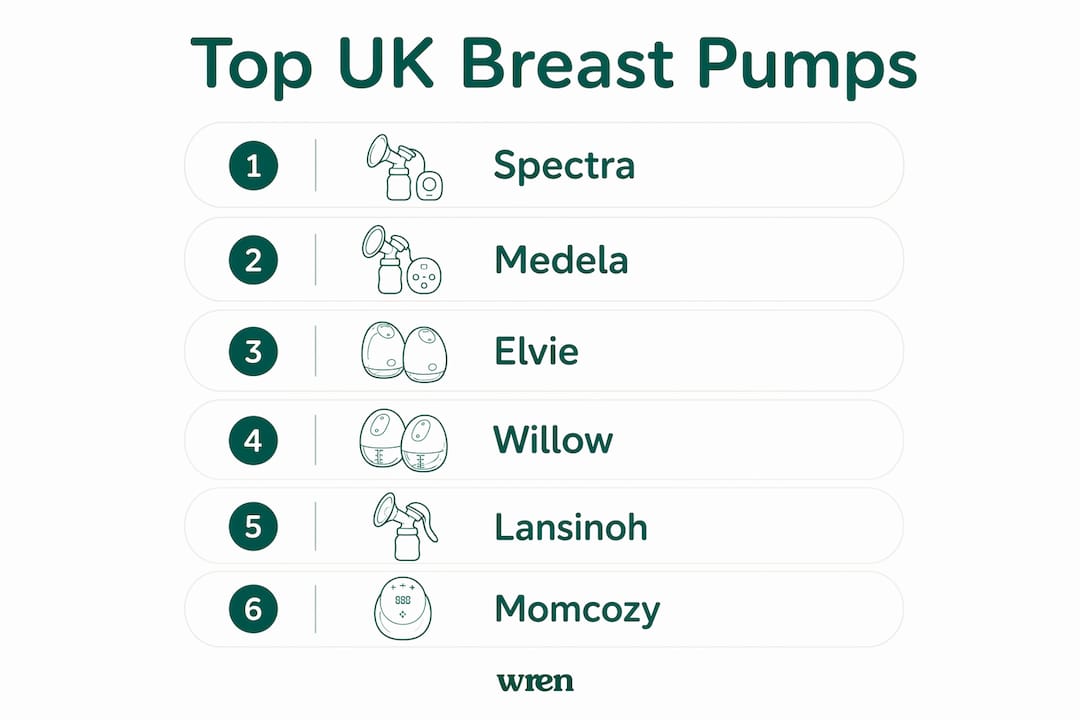
Spectra, Medela, Elvie, Willow, Lansinoh, and Momcozy are the best breast pump brands available to UK mothers in 2026, each leading in a distinct category, with options that can be complemented by plant-based ingredients for scalp health to support holistic postpartum care. Spectra and Medela dominate for power and reliability. Elvie and Willow set the standard for wearable, hands-free pumping. Lansinoh covers manual and budget-friendly options. Momcozy has become the go-to for affordable wearables. The right choice depends on how often you plan to pump, whether you need to pump at work or on the move, and what your budget allows.
The comparison below covers the full range of pump types, from hospital-grade double electrics to compact silicone catchers, so you can match a model to your actual situation rather than a generalised recommendation.
| Product | Best for | Pump type | Portability | Price range | Key features | Ease of cleaning |
|---|---|---|---|---|---|---|
| Spectra S1 Plus | Exclusive pumping | Double electric | Moderate (battery) | £££ | Hospital-grade motor, quiet, night light | Easy, closed system |
| Spectra S2 Plus | Home-based pumping | Double electric | Low (mains only) | ££ | Hospital-grade power, customisable settings | Easy, closed system |
| Spectra SG Portable | Travel, on-the-go | Double electric | High (battery) | £££ | Compact, reliable suction, portable | Easy, closed system |
| Medela Freestyle | Working mothers | Double electric | High (battery) | £££ | Long battery life, compact, app connectivity | Moderate |
| Medela Harmony Flex | Manual, comfort | Manual | Very high | £ | Soft flanges, ergonomic lever, efficient | Very easy |
| Medela Harmony | Occasional, backup | Manual | Very high | £ | Lightweight, simple assembly | Very easy |
| Medela Motion InBra Wearable Breast Pump | Discreet in-bra use | Wearable electric | Very high | ££££ | In-bra design, quiet, app-connected | Moderate |
| Elvie Pump | Hands-free, active lifestyle | Wearable electric | Very high | ££££ | App integration, silent, in-bra | Moderate |
| Elvie Stride 2 | Wearable with tubing | Wearable electric | High | £££ | Quieter than traditional, hands-free | Moderate |
| Willow 360 | Discreet travel pumping | Wearable electric | Very high | ££££ | Spill-proof bags, silent, 360° movement | Moderate |
| Willow Go | Budget wearable | Wearable electric | Very high | £££ | Hands-free, reusable container, quieter | Moderate |
| Lansinoh 2-in-1 Double Electric Breast Pump | Versatile home use | Double electric | Moderate | ££ | Dual mode, customisable, closed system | Easy |
| Lansinoh Wearable Electric Breast Pump | Wearable on a budget | Wearable electric | Very high | ££ | Hands-free, lightweight, quiet | Easy |
| Lansinoh Wearable Pump Double | Double wearable use | Wearable electric | Very high | ££ | Double wearable, discreet | Easy |
| Lansinoh Rechargeable Double Electric Pump | Rechargeable home use | Double electric | Moderate | ££ | Rechargeable battery, closed system | Easy |
| Lansinoh Manual Breast Pump | Occasional, budget | Manual | Very high | £ | Ergonomic, soft flange, compact | Very easy |
| Momcozy S12 Pro | Best-value wearable | Wearable electric | Very high | ££ | Hands-free, quiet, multiple modes | Easy |
| Momcozy M5 Wearable Breast Pump | Active mothers, budget | Wearable electric | Very high | £ | Compact, affordable, hands-free | Easy |
| Momcozy M6 Mobile Style Hands-free Breast Pump | Hands-free mobility | Wearable electric | Very high | ££ | Mobile, lightweight, multiple modes | Easy |
| Momcozy M9 Mobile Flow Hands Free Breast Pump | Hands-free, mobile | Wearable electric | Very high | ££ | Flow control, quiet, portable | Easy |
| Momcozy Air 1 Ultra-Slim Breast Pump | Ultra-slim wearable | Wearable electric | Very high | ££ | Slim profile, discreet, lightweight | Easy |
| Momcozy V2 Pro Hospital Grade Breast Pump | Intensive pumping | Double electric | Moderate | £££ | Hospital-grade motor, powerful suction | Easy |
| Eufy S1 Pro Wearable Breast Pump | Power and discretion | Wearable electric | Very high | £££ | Strong suction, quiet, wearable | Moderate |
| BabyBuddha Portable Breast Pump 2.0 | Portable power | Double electric | High (battery) | £££ | Compact, powerful, travel-friendly | Easy |
| MAM Move Wearable Breast Pump | Wearable, MAM users | Wearable electric | Very high | ££ | Quiet, lightweight, hands-free | Easy |
| Pippeta LED Wearable Hands-free Breast Pump | Wearable with LED | Wearable electric | Very high | ££ | LED display, quiet, compact | Easy |
| Lola & Lykke Smart Electric Breast Pump | Smart features | Double electric | Moderate | £££ | App-connected, multiple modes | Easy |
| Fraupow Wearable Breast Pump | Wearable, UK brand | Wearable electric | Very high | ££ | Compact, quiet, rechargeable | Easy |
| Haakaa Silicone Breast Pump | Passive letdown collection | Passive manual | Very high | £ | Silicone, no motor, catches letdown | Very easy |
| My-wren Double Wearable Pump | Wearable, lifestyle fit | Wearable electric | Very high | ££ | Double wearable, discreet, rechargeable | Easy |
Detailed brand and product comparisons
The six major brands each occupy a distinct position in the UK market. Understanding what each does best is more useful than comparing raw spec sheets.
Spectra
Spectra is the most recommended brand for mothers who plan to pump frequently or exclusively. The Spectra S1 Plus is the standout model: a hospital-grade double electric pump with a built-in rechargeable battery, a quiet motor, and a closed system that prevents milk from reaching the tubing or motor. It has been a top-rated pick among exclusive pumpers since 2018, according to testing by the Wirecutter team at the New York Times. The Spectra S2 Plus offers the same motor power at a lower price point but runs on mains power only, making it better suited to home use. For mothers who need hospital-grade suction on the move, the Spectra SG Portable delivers comparable performance in a smaller, battery-powered body.
Spectra pumps use a closed system design, which prevents milk contamination of the motor and tubing. This matters both for hygiene and for long-term pump safety, particularly for mothers who pump multiple times daily.
Medela
Medela is the most established name in breast pumping globally, and its UK range covers every pump category. The Medela Freestyle is the brand’s flagship portable double electric, with a long battery life and a compact form factor suited to working mothers. The Medela Motion InBra Wearable Breast Pump sits at the premium end of the wearable category, fitting entirely inside a nursing bra with app connectivity. For manual pumping, the Medela Harmony Flex offers soft flanges and an ergonomic lever that reduces hand fatigue, while the standard Medela Harmony is a reliable, lightweight backup option.
Medela’s two-phase technology, which shifts between a faster stimulation mode and a slower expression mode, is now standard across most of its electric range. This mimics a baby’s natural feeding pattern and is designed to improve milk flow.
Elvie
Elvie changed the wearable pump category when the Elvie Pump launched as one of the first truly in-bra, tubeless wearables. It fits inside a nursing bra, connects to a smartphone app for tracking output, and operates quietly enough to use in most office environments. The Elvie Stride 2 is a more recent addition: it uses a hub-and-tube design rather than fitting entirely in-bra, which gives it stronger suction than the original Elvie Pump while retaining hands-free convenience. Both are available in the UK and are well-suited to working mothers who need to pump discreetly during the day.
Willow
Willow’s key differentiator is its spill-proof technology. The Willow 360 uses proprietary bags that seal at any angle, meaning mothers can lean forward, lie down, or move freely without risk of spilling. It is one of the quietest pumps available and is particularly popular for travel. The Willow Go is a more affordable version that uses a reusable container rather than disposable bags, making it a practical everyday option for mothers who want wearable convenience without the ongoing cost of replacement bags.
Lansinoh
Lansinoh covers the widest price range of any brand in this comparison. At the budget end, the Lansinoh Manual Breast Pump is compact, easy to clean, and well-suited to occasional use or as a travel backup. The Lansinoh 2-in-1 Double Electric Breast Pump offers a closed system, dual pumping modes, and customisable settings at a mid-range price. Lansinoh has also expanded into wearables with the Lansinoh Wearable Electric Breast Pump and the Lansinoh Wearable Pump Double, both of which offer hands-free pumping at a lower price than Elvie or Willow. The Lansinoh Rechargeable Double Electric Pump adds battery flexibility to the brand’s traditional double electric range.
Momcozy
Momcozy has grown rapidly in the UK market by offering wearable pumps at prices well below Elvie and Willow. The Momcozy S12 Pro is the brand’s most popular model and is frequently cited as the best-value wearable available. The Momcozy M5 is the entry-level option for mothers on a tight budget. The M6 and M9 add flow control and additional pumping modes. For mothers who need more power, the Momcozy V2 Pro Hospital Grade Breast Pump delivers professional-level suction in a traditional double electric format. The Momcozy Air 1 Ultra-Slim is the brand’s slimmest wearable, designed for maximum discretion under clothing.
Other brands worth noting
The Eufy S1 Pro Wearable Breast Pump combines strong suction with quiet operation in a wearable format, making it one of the few wearables that does not require a significant trade-off in power. The BabyBuddha Portable Breast Pump 2.0 is a compact double electric with a powerful motor, popular among mothers who want portability without sacrificing suction. The Haakaa Silicone Breast Pump is a passive manual pump that collects letdown from one breast during feeding on the other. It requires no power, has no parts to assemble, and is one of the easiest products to clean. The Pippeta LED Wearable Hands-free Breast Pump, Fraupow Wearable Breast Pump, MAM Move Wearable Breast Pump, and Lola & Lykke Smart Electric Breast Pump all serve the wearable and smart-pump segment, with varying price points and feature sets suited to different preferences.
Pro Tip: Battery life and noise level vary considerably across wearable brands. Forbes Vetted’s 2026 wearable pump testing found that longer battery life and quiet operation are the two features users most frequently cite as priorities when choosing between models.
How to choose the right breast pump for your lifestyle
The most useful question to ask before buying is not “which pump is best?” but “how often will I actually pump, and where?” The answer to that shapes every other decision.
Pumping frequency and type
Mothers who plan to pump exclusively, or who need to establish and maintain supply from the start, need a double electric pump with a motor rated to at least 250 mmHg of suction, according to lactation consultants cited by Consumer Reports. The Spectra S1 Plus and Spectra S2 Plus are the most commonly recommended options in this category. Mothers who plan to pump occasionally, to relieve engorgement or build a small freezer stash, can manage well with a manual pump or a mid-range single electric.

Wearable pumps suit mothers who need to pump at work or during commutes. They trade some suction power for portability and discretion, so they work best as a secondary pump rather than a primary one for mothers with high output demands. The NHS guidance on expressing notes that many mothers find hand expressing effective for occasional needs, and that waiting until after birth to purchase a pump allows a more informed decision based on actual feeding experience.
Budget
Manual pumps from Lansinoh and Medela start below £30. Mid-range double electrics from Lansinoh and Spectra S2 Plus sit in the £100–£200 range. Premium wearables from Elvie and Willow typically cost £250–£400. Momcozy and Lansinoh wearables offer hands-free convenience at £60–£150, making them the most accessible entry point into the wearable category.
Flange sizing
An ill-fitting flange is one of the most common causes of discomfort and reduced milk output, regardless of how powerful the pump is. Correct flange sizing is measured by nipple diameter and should be checked before purchasing. Most brands offer replacement flanges in multiple sizes, but it is worth confirming compatibility before committing to a pump.
Ease of cleaning
Closed system pumps, including all Spectra models and most Lansinoh electrics, prevent milk from entering the tubing or motor. This makes them significantly easier to clean and safer for prolonged use. Open system pumps require more careful maintenance. Wearable pumps generally have fewer parts than traditional double electrics, but the cups and valves still need thorough cleaning after each session.
Buying priorities at a glance:
- Pumping frequency: exclusive pumpers need hospital-grade power; occasional pumpers can use manual or mid-range electric
- Portability: wearables for commuting and travel; traditional double electrics for home use
- Budget: manual pumps from £15; wearables from £60; premium wearables up to £400
- Flange fit: measure nipple diameter before buying and confirm replacement sizes are available
- Closed system: prioritise for hygiene, especially for frequent or long-term use
- Noise level: wearables are generally quieter; important for office or public use
- Battery life: check charge duration against your typical pumping schedule
Pro Tip: Wait until after birth and, ideally, until breastfeeding is established before purchasing a pump. Your actual feeding pattern will tell you far more about what you need than any pre-birth estimate.
How these pumps were evaluated
The rankings and recommendations in this article are based on a structured review process drawing on expert testing, published clinical guidance, and real user feedback from UK mothers.
Evaluation criteria
- Suction power: measured in mmHg where published; cross-referenced against lactation consultant benchmarks
- Comfort: flange design, suction modes, and user-reported pain or discomfort
- Portability: weight, battery life, and whether the pump can be used without a mains connection
- Noise level: decibel ratings where available; user-reported assessments for wearables
- Ease of cleaning: number of parts, dishwasher compatibility, and closed versus open system design
- Price and value: UK retail price relative to features and pump type
- UK availability: only pumps available to buy in the UK through mainstream retailers or direct from brand websites are included
- After-sales support: warranty length, UK customer service access, and spare parts availability
Testing and review process
Product specifications were compared against published clinical guidance from the Imperial NHS Trust and the NHS’s own expressing guidance. User satisfaction data was drawn from large-scale testing programmes, including the What to Expect panel of over 300 mothers and the Wirecutter’s testing of 14 pumps across multiple sessions. Expert input from International Board Certified Lactation Consultants (IBCLCs) informed the weighting given to suction power, flange design, and pump type suitability.
Evaluation steps:
- Reviewed published suction power and mode specifications for each pump
- Cross-referenced user feedback from UK and US testing panels
- Assessed closed versus open system design for hygiene and cleaning ease
- Confirmed UK retail availability and warranty terms
- Weighted practical factors (noise, portability, cleaning) alongside technical performance
Expert insights for better pumping results
Lactation experts consistently point out that practical factors outweigh technical specifications for most mothers. A pump that is easy to assemble, quick to clean, and quiet enough to use at work will be used more consistently than a more powerful model that sits in a cupboard because it is too cumbersome.
Wearables versus traditional pumps
Wearable pumps offer genuine convenience, but they are not a direct replacement for a double electric in most cases. Imperial NHS guidance notes that wearables typically sacrifice some power and milk yield compared to traditional hospital-grade pumps. Most experienced mothers who pump regularly use a double electric as their primary pump and a wearable for occasions when discretion or mobility matters more than maximum output.
Closed system design
Closed system pumps create a physical barrier between the milk collection area and the motor. This prevents milk backflow into the tubing and motor, which matters both for hygiene and for the pump’s longevity. Older open system designs carry a risk of milk contamination in the motor, which can be difficult to clean and may affect pump performance over time. All Spectra models use a closed system. Medela’s electric range and most Lansinoh electrics do too.
Timing your purchase
Buying a pump before birth is common, but it often leads to a mismatch between the pump and actual needs. The NHS advises waiting until breastfeeding is established before committing to a specific model. If a pump is needed immediately after birth for clinical reasons, NHS trusts can facilitate rental of hospital-grade pumps, which avoids the cost of buying a pump that may not suit long-term needs.
Pro Tip: If you are returning to work and plan to pump during the day, read through breastfeeding tips for working mothers before deciding between a wearable and a portable double electric. The logistics of your workplace will often make the decision for you.
Best practices for pumping success:
- Establish breastfeeding before introducing a pump where possible
- Measure nipple diameter and confirm flange size before first use
- Use a double electric as the primary pump for exclusive or frequent pumping
- Reserve a wearable for commuting, travel, or office sessions
- Clean all pump parts after every session, following CDC breast pump hygiene guidance
- Check warranty terms and UK spare parts availability before purchasing
- Consider a silicone passive pump like the Haakaa as a low-effort supplement during feeds
My-wren wearable pumps: a different approach to expressing

The pumps compared in this article cover the full range of what is available from major brands. My-wren offers a different entry point: a double hands-free wearable electric pump designed for mothers who want the convenience of a wearable without the premium price of Elvie or Willow. My-wren’s pump is rechargeable, discreet under clothing, and built for everyday use at home or at work.
Beyond the pump itself, My-wren stocks a full range of breastfeeding accessories and essentials including reusable breast pads, nipple balms, lactation massagers, and milk storage bags, alongside breastfeeding kits and bundles that bring the most-used products together in one order. For mothers who want to try a wearable pump without committing to a £300-plus spend, My-wren’s range is worth considering alongside the established names.
Key takeaways
Spectra and Medela lead for power and reliability, Elvie and Willow for wearable innovation, and Lansinoh and Momcozy for accessible pricing across both electric and wearable categories.
| Point | Details |
|---|---|
| Match pump type to frequency | Exclusive pumpers need a hospital-grade double electric; occasional pumpers can use a manual or mid-range model. |
| Wearables trade power for portability | Wearable pumps are quieter and hands-free but typically deliver less suction than traditional double electrics. |
| Closed system matters | Closed system pumps prevent milk contamination of the motor, improving hygiene and long-term pump safety. |
| Flange fit affects output | An ill-fitting flange causes discomfort and reduces milk yield regardless of pump power; measure before buying. |
| My-wren for wearable value | My-wren’s double wearable pump offers hands-free expressing at a mid-range price, with accessories and bundles available. |


