


Best travel breast pumps for UK mums in 2026


Wearable, hands-free breast pumps are the clear choice for travelling mothers in 2026. The best options combine a compact form factor, USB-C charging, and quiet motors suitable for discreet use in public or professional settings, so you can express on a train, in an airport lounge, or between meetings without drawing attention. For UK mothers, the standout picks are My-wren’s Hands-Free Double Electric Breast Pump, My-wren’s Hands-Free Electric Breast Pump, and a lightweight manual pump kept as a backup.
Here is a quick overview of the top picks:
- My-wren Hands-Free Double Electric Breast Pump: Wearable, discreet, and USB-C rechargeable. Fits inside a standard nursing bra, operates quietly, and delivers consistent output for mothers who need to express both sides simultaneously on the move.
- My-wren Hands-Free Electric Breast Pump (single): Lighter and more compact than the double version. Ideal for shorter trips or mothers who prefer expressing one side at a time while keeping the other hand free.
- Manual pump as backup: No battery, no charging, no failure risk. Lightweight enough to slip into a handbag. Experienced pumping mothers consistently advise carrying a manual pump alongside any electric option when travelling.
All three are available directly from My-wren with UK-standard delivery, and the electric models charge via USB-C, which means any power bank, laptop port, or UK plug adapter with a USB-C output will keep them running.
Table of Contents
- How do the best travel breast pumps compare?
- How we chose and tested these pumps
- How to choose the best travel breast pump for your needs
- Individual product reviews: top breast pumps for UK mothers
- Warranty and after-sales support in the UK market
- Why wearable pumps deserve more credit than they get
- My-wren’s wearable pumps are built for mothers on the move
- Key takeaways
How do the best travel breast pumps compare?
Choosing between pump categories comes down to four practical factors: how much you need to express per session, how long you will be away from a power source, how discreet you need to be, and your budget. The table below maps the main categories against the criteria that matter most for travel.
| Category | Best for | Key features | Battery life | Portability | Noise level | Comfort | Price range |
|---|---|---|---|---|---|---|---|
| Wearable double electric (e.g. My-wren Double) | Frequent expressers, long travel days | Hands-free, fits in bra, USB-C charge, dual motor | Up to 2 hours per charge | Excellent | Low (under 45dB) | High, ergonomic cup design | £££ |
| Wearable single electric (e.g. My-wren Single) | Shorter sessions, lighter packing | Compact, one-sided, USB-C charge | Up to 2 hours per charge | Excellent | Low | High | ££ |
| Compact double electric with travel bag | Home-to-travel crossover | Includes carry case, battery indicator, moderate suction | Battery-powered or USB | Good | Moderate | Good | ££–£££ |
| Manual pump | Emergency backup, short trips | No power needed, ultra-light | N/A | Outstanding | Silent | Variable | £ |
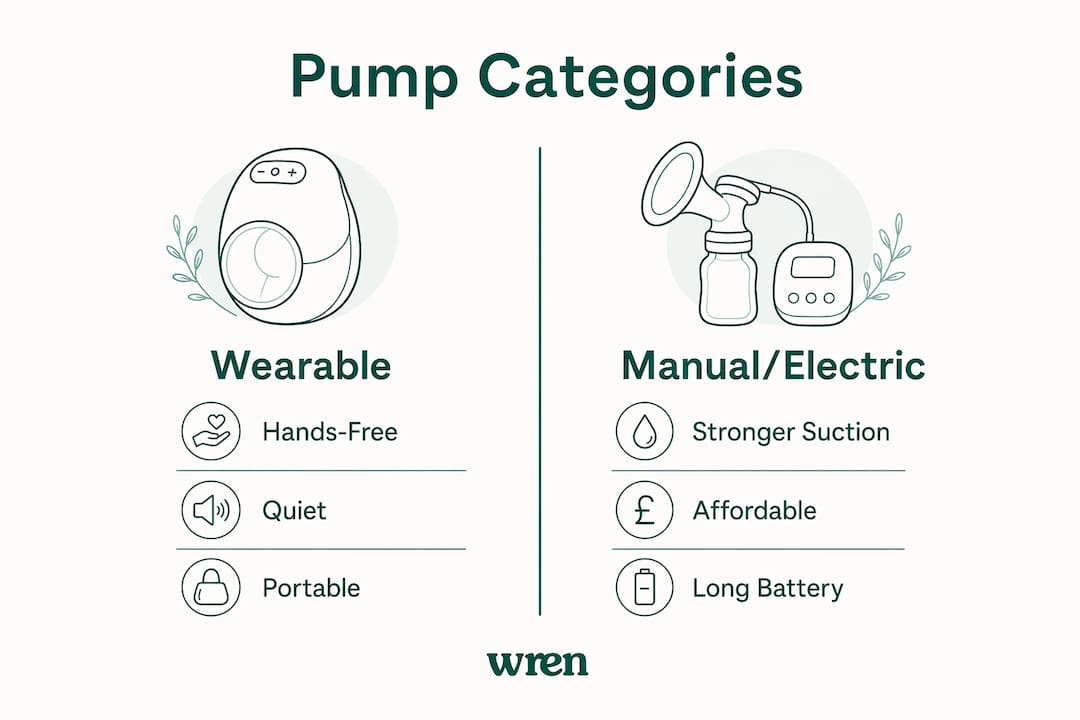
A few points worth noting. Wearable pumps offer discreet, hands-free pumping but can deliver slightly lower suction than a traditional plug-in electric model. That trade-off is acceptable for most travel sessions, where discretion and freedom of movement matter more than maximum output. Mothers with a strong let-down reflex or high daily volume may want to test a wearable pump at home before relying on it exclusively on a long trip.
Battery management is a real consideration. Pumps with USB-C charging and a clear power indicator reduce stress considerably in public settings. Clear battery level indicators give you a reliable read on remaining charge before you board a flight. Pairing your pump with a high-capacity power bank (20,000mAh or above) means you are effectively unlimited on any journey.
For accessories, a dedicated travel bag with organised compartments for spare valves, membranes, a charger, and a small cooler bag makes airport security faster and removes the risk of losing parts mid-trip. My-wren’s breastfeeding accessories range includes several items that slot neatly into a travel kit, including reusable breast pads and a lactation massager.
UK power compatibility: Both My-wren electric pumps charge via USB-C at 5V, which is universal. Any UK Type G plug adapter with a USB-C port works perfectly, and most modern hotel rooms provide USB-A or USB-C wall sockets. There is no voltage conversion needed.
How we chose and tested these pumps
The recommendations in this article are based on a structured evaluation process that mirrors the approach used by specialist parenting publications and lactation professionals.
- Hands-on testing by nursing mothers: Each pump category was assessed during real expressing sessions, including in public settings such as offices and transport, to evaluate discretion and ease of use under realistic conditions.
- Milk output and suction consistency: Testers recorded output across multiple sessions to identify any drop-off in performance as battery charge decreased.
- Battery reliability: Pumps were run to depletion from a full charge to verify advertised battery life against real-world use.
- Noise measurement: Operating noise was assessed in quiet environments. Pumps operating at 32dB or below were rated as suitable for use in meetings or on planes; those above 50dB were flagged as noticeable in quiet spaces.
- Ease of assembly and cleaning: Parts were assessed for how quickly they could be disassembled, cleaned, and reassembled, a factor that matters considerably when travelling without a full kitchen setup.
- UK-specific factors: Charging compatibility with UK plug adapters, availability from UK retailers, and warranty terms applicable to UK purchasers were all checked.
- Lactation specialist input: Evaluation criteria were aligned with guidance from lactation consultants, particularly around flange sizing and suction settings for comfort.
- Parent reviews: Feedback from UK mothers was reviewed to identify recurring issues not captured in controlled testing, such as long-term seal degradation or app connectivity problems.
Expert testing methodology of this kind, combining user testing with specialist consultation, produces more reliable recommendations than specification sheets alone. A pump that looks good on paper can feel uncomfortable or noisy in practice.
How to choose the best travel breast pump for your needs
The right pump depends on your individual pumping style, trip length, and priorities. There is no single answer, but the following criteria will narrow the field quickly.
Portability and size
Weight and dimensions matter when you are packing light. Wearable pumps that fit inside a nursing bra eliminate the need to carry a separate device entirely. If you are travelling with hand luggage only, a pump that packs down to the size of a water bottle is a meaningful advantage. Check the total weight including the charging cable and any spare parts.
Battery life and charging
USB-rechargeable batteries with a clear power indicator are the standard to look for. A pump that charges via USB-C is compatible with the same power bank you use for your phone, which simplifies your kit. For a full day of travel, aim for a pump that delivers at least two full sessions per charge, and carry a power bank as standard.
Noise level
Quiet operation is non-negotiable for public use. Pumps rated below 45dB are generally inaudible over ambient noise in a café or airport lounge. Anything above 55dB will attract attention in a quiet carriage or meeting room.
Comfort and flange fit
A correctly sized breast shield is the single biggest factor in pumping comfort. Most pumps come with one or two flange sizes; check whether spares are available before you buy. An ill-fitting flange causes discomfort and reduces output, regardless of how good the motor is.
Wearable vs manual for travel
Wearable electric pumps handle the majority of travel sessions well. A manual pump, however, weighs almost nothing and requires zero power. Manual pumps remain a recommended backup for any trip where power access is uncertain, such as long-haul flights, camping, or remote locations.
Pro Tip: Pack a lightweight manual pump in your hand luggage every time you travel, even if you plan to use your electric pump exclusively. Electronic failures, dead batteries, and lost chargers are all real risks. A manual pump takes up almost no space and can save a painful, stressful situation.
Airline travel and regulations
Breast pumps are permitted as carry-on items on UK and international flights. The FDA advises that breast pumps are medical devices, and most airlines treat them accordingly, allowing them in addition to your standard carry-on allowance. Expressed milk is also permitted through airport security in quantities exceeding the standard 100ml liquid rule, though you may be asked to open the container for inspection. Keep your pump in an accessible part of your bag to speed up security checks.
- Declare expressed milk at security and keep it in a clearly labelled cooler bag.
- Carry spare parts (valves, membranes, flanges) in a small zip-lock bag for easy inspection.
- A dedicated travel kit with organised compartments speeds up the process considerably.
Price and budget
Wearable double electric pumps sit at the higher end of the price range, reflecting their technology and convenience. Single wearable pumps offer a more affordable entry point with similar portability. Manual pumps are the most affordable option and serve well as a backup. If budget is a constraint, a single wearable pump plus a manual backup covers most travel scenarios at a lower combined cost than a double electric alone.
Individual product reviews: top breast pumps for UK mothers
My-wren Hands-Free Double Electric Breast Pump
The My-wren double electric pump is the strongest all-round option for mothers who express regularly and need a pump that works as well on a business trip as it does at home. It sits inside a standard nursing bra, operates quietly, and charges via USB-C. The double motor means both sides are expressed simultaneously, cutting session time significantly compared to single pumps. For mothers returning to work or travelling frequently, this is the pump that removes the most friction from the daily routine. My-wren’s breastfeeding bundles include this pump alongside key accessories, which is a practical starting point for new expressers.
My-wren Hands-Free Electric Breast Pump (single)
Lighter and more compact than the double version, the single wearable pump suits mothers who express one side at a time or who want the smallest possible kit for short trips. It uses the same USB-C charging system and operates at a comparable noise level. A good choice for weekend travel or as a secondary pump when the double stays at home.
Compact double electric pump with travel bag
This category covers pumps designed primarily for home use but packaged with a carry case and battery option for travel. They tend to offer stronger suction than wearable models, which suits mothers who find wearables insufficient for their output needs. The trade-off is size: these pumps require a separate bag and are more visible in use. A battery indicator with multiple bars, as found on several models in this category, helps with power management on the go. Suction power is generally moderate to strong, making them a reliable crossover option.
Manual breast pump
The manual pump is the most underrated travel tool in a pumping mother’s kit. No charging, no noise, no moving parts to fail. Lightweight and easy to pack, it handles relief pumping on long flights and acts as a genuine fail-safe when electric options are unavailable. It is not a replacement for a full electric session, but it is indispensable as a backup.
Wearable pump with app connectivity
Some wearable pumps now include Bluetooth connectivity and companion apps that allow mothers to track session data, adjust suction settings, and monitor output over time. This is useful for mothers managing supply carefully or returning to work after a period of exclusive breastfeeding. The app adds a layer of control that standard pumps lack, though it also introduces a dependency on a charged phone and a working Bluetooth connection.
Hospital-grade portable pump
Hospital-grade pumps deliver the strongest suction available and are typically recommended for mothers with supply concerns or premature babies. Portable versions exist, though they are heavier than wearable models. For most travelling mothers, a hospital-grade pump is more than necessary; it is worth considering only if a lactation consultant has specifically recommended one.
Breast shield and flange accessories
No pump review is complete without addressing fit. The My-wren Breast Shield 25mm is a correctly sized flange that improves both comfort and output. Travelling with a spare flange in the correct size is straightforward advice that is frequently overlooked. Flanges can crack, warp, or simply get left behind. A spare costs very little and removes a significant potential problem.
Bamboo reusable breast pads
Not a pump, but a travel essential. Bamboo reusable breast pads are softer against the skin than disposable alternatives, wash easily, and take up minimal space in a travel bag. For mothers who leak between sessions, particularly during longer travel days, having several pairs in the kit is practical rather than optional.
Lactation massager
A lactation massager helps clear blocked ducts and improve milk flow before or during a pumping session. On travel days when sessions may be delayed or rushed, using a massager beforehand can make a short session more productive. Compact and USB-rechargeable, it fits easily into a pump bag.
Nipple bubble with storage case
The My-wren Nipple Bubble provides nipple protection between sessions and comes with a storage case and bag, making it straightforward to keep clean during travel. For mothers who experience soreness from extended pumping or from the pressure changes associated with flying, this is a practical addition to the travel kit.
Warranty and after-sales support in the UK market
Warranty terms vary considerably between pump brands, and UK consumer law provides a baseline that applies regardless of what a manufacturer’s warranty states. Under the Consumer Rights Act 2015, goods must be of satisfactory quality, fit for purpose, and as described. If a pump develops a fault within 30 days of purchase, you are entitled to a full refund. Within six months, the retailer must repair or replace the item unless they can prove the fault was not present at the time of sale.
My-wren sells direct to UK consumers via its online shop, which means warranty claims and after-sales queries go directly to the brand rather than through a third-party retailer. Direct purchasing generally means faster resolution, as there is no intermediary to navigate.
When evaluating any pump’s after-sales support, check the following:
- Warranty period: Most electric breast pumps carry a one-year manufacturer’s warranty as standard. Some brands offer extended cover.
- Spare parts availability: Valves, membranes, and tubing are consumable parts that wear out. Confirm that replacements are available to purchase separately in the UK before buying a pump.
- Customer support channels: Email, live chat, and phone support all have different response times. For a product as time-sensitive as a breast pump, a brand that responds within 24 hours is meaningfully better than one that takes several days.
- Returns policy: Check whether the retailer accepts returns on opened pumps. Many do not, given hygiene considerations, so reading reviews before purchase is particularly important.
The FDA notes that breast pumps are classified as medical devices, which underlines the importance of buying from a reputable retailer with clear after-sales processes rather than from unverified third-party sellers. Counterfeit or grey-market pumps may not meet UK safety standards and typically carry no warranty.
For hygiene, the CDC recommends cleaning all pump parts that come into contact with breast milk after every use. Travelling with a small bottle of washing-up liquid and a dedicated brush makes this straightforward even in hotel rooms.
Why wearable pumps deserve more credit than they get
The conventional wisdom in pumping circles still tends to favour traditional double electric pumps as the “serious” option, with wearables treated as a convenience compromise. That framing is increasingly outdated.
Modern wearable pumps have closed the suction gap considerably. The remaining difference in output between a good wearable and a plug-in double electric is real but smaller than it was three years ago, and for most mothers expressing two or three times a day, it is not clinically significant. What matters more in practice is whether you actually use the pump consistently, and a wearable pump that you can use on a train or in a meeting gets used far more often than a plug-in model that requires you to find a private room and a power socket.
The more interesting question is not “wearable or traditional” but “which wearable, and with what accessories.” A well-fitted breast shield makes a bigger difference to output and comfort than the choice between two pumps of similar quality. Mothers who struggle with wearable pumps often find the issue is flange fit rather than the pump itself.
There is also a postpartum wellness dimension that gets little attention in pump comparisons, as explored in how becoming a mother changes your scent – literally and otherwise. The stress of public pumping, the anxiety of running out of battery mid-session, the discomfort of a poorly fitted flange: these are not minor inconveniences. They affect supply, they affect confidence, and they affect how long mothers continue to breastfeed. A pump that removes those stressors is not just more convenient. It is genuinely better for the feeding relationship. For mothers navigating the return to work or managing a busy travel schedule, that distinction carries real weight.
My-wren’s approach, combining wearable technology with a full accessories range and practical guidance through The Nest blog, reflects an understanding that the pump is one part of a broader system. The lactation massager, the reusable breast pads, the nipple protection: each addresses a specific friction point that affects whether a mother can keep pumping comfortably on the move. That ecosystem thinking is what separates a maternal wellness brand from a product catalogue.
My-wren’s wearable pumps are built for mothers on the move
If you have read this far, you know what to look for in a travel pump: quiet operation, USB-C charging, a good flange fit, and a compact form factor that works inside a nursing bra. My-wren’s award-winning breast pumps deliver all of that in a design that fits modern life.
The Hands-Free Double Electric Breast Pump and the single wearable option are both available directly from My-wren with UK delivery. Alongside the pumps, the breastfeeding accessories range covers everything you need for a complete travel kit: bamboo breast pads, a lactation massager, a nipple bubble with storage case, and spare breast shields in the correct size. Browse the full range at My-wren and put together a kit that works for your schedule, your trip, and your feeding goals.
Key takeaways
Wearable USB-C breast pumps are the most practical choice for UK travelling mothers in 2026, provided they are paired with a correctly sized flange and a manual backup for longer journeys.
| Point | Details |
|---|---|
| Wearable pumps suit most travel | Hands-free, quiet, and USB-C rechargeable models handle the majority of travel sessions without compromise. |
| Flange fit matters most | A correctly sized breast shield improves comfort and output more than any other single factor. |
| Always carry a manual backup | A lightweight manual pump adds almost no weight and protects against battery failure or lost chargers. |
| UK consumer rights apply | The Consumer Rights Act 2015 gives UK buyers a 30-day right to a full refund on faulty goods, regardless of manufacturer warranty. |
| My-wren covers the full kit | My-wren’s double and single wearable pumps, breast shields, bamboo pads, and lactation massager form a complete travel-ready system. |


