


High lipase milk: what parents need to know


High lipase milk is defined as breast milk that contains elevated enzyme activity, causing stored milk to develop a soapy, metallic, or sour smell and taste within hours or days of expression. The milk itself remains completely safe. Lipase in milk retains all nutrients and antibodies regardless of how altered the taste becomes. This is one of the most misunderstood aspects of breastfeeding, and it causes many parents to discard perfectly good milk unnecessarily. Understanding what lipase does, how to spot it, and how to manage it puts you back in control of your feeding routine.
What is high lipase milk and how does it affect stored breast milk?
Lipase is a natural enzyme present in all breast milk. Its primary role is to help babies digest milk fats by breaking them down into free fatty acids that are easy to absorb. In some parents, this enzyme is particularly active, continuing to break down fats even after milk has been expressed and stored.

The result is a noticeable change in smell and taste. Stored milk develops a soapy or metallic odour as lipase breaks down fats into free fatty acids, lowering the milk’s pH. This process is entirely unrelated to spoilage. The milk has not gone off. It has simply undergone an enzymatic change.
The table below shows how normal milk and high lipase breast milk differ during storage.
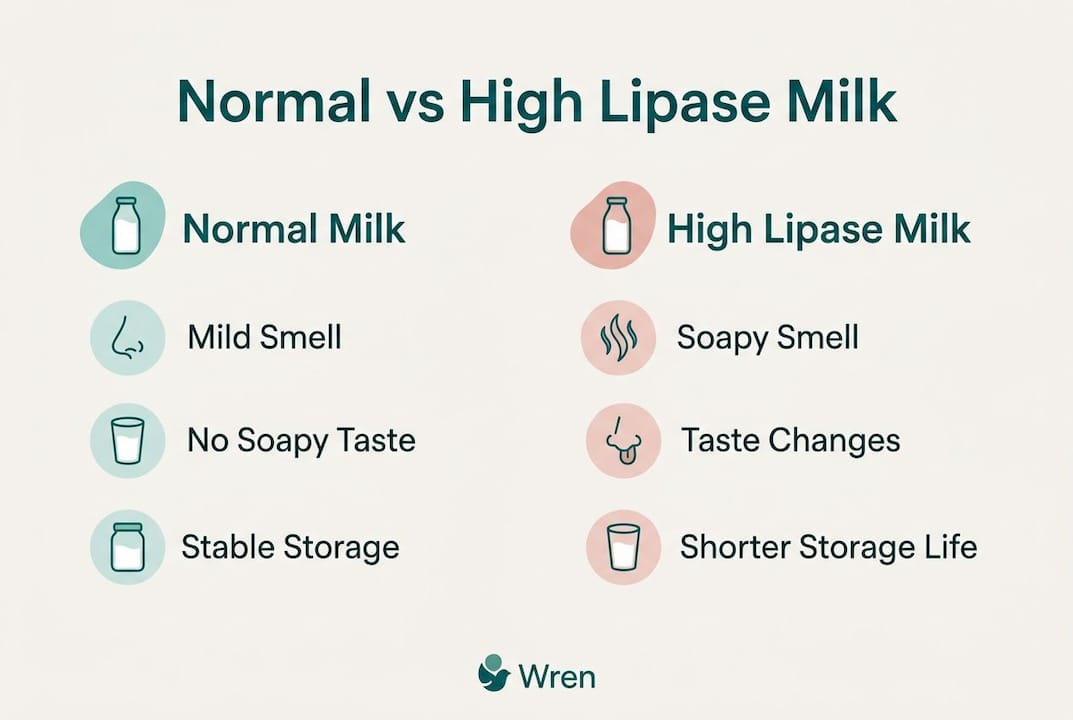
| Feature | Normal milk | High lipase milk |
|---|---|---|
| Smell after 24 hrs in fridge | Mild, slightly sweet | Soapy, metallic, or sour |
| Taste after storage | Neutral to slightly sweet | Noticeably soapy or bitter |
| Appearance | White or slightly yellow | No visible difference |
| Nutritional value | Complete | Complete |
| Safety for baby | Safe | Safe |
A common point of confusion is the difference between lipase activity and oxidation. Oxidised milk smells fishy or rancid and is caused by exposure to light, air, or certain foods in the parent’s diet. Lipase activity produces a soapy or metallic note specifically. Knowing which one you are dealing with matters, because the solutions are different.
Signs that point to high lipase activity include:
- Soapy or metallic smell developing within 12–24 hours of refrigeration
- Taste that changes noticeably between fresh and stored milk
- No change in the milk’s appearance or colour
- Baby refusing stored milk but feeding well from the breast or freshly expressed milk
Is high lipase milk safe for babies?
High lipase milk is 100% safe and nutritionally complete for babies, despite the altered smell and taste. The enzyme activity changes the sensory profile of the milk but does not destroy its antibodies, proteins, fats, or vitamins. Medical consensus supports this clearly.
Lipase is a vital component of breast milk. It actively supports fat digestion in infants by breaking down milk fats into fatty acids that the gut can absorb efficiently. Elevated lipase activity does not make milk harmful. It simply means the enzyme is doing its job more quickly than average.
The distinction between “spoiled” milk and milk altered by lipase is worth stating plainly. Spoiled milk has been contaminated by bacteria and poses a genuine health risk. It smells strongly rotten, may appear curdled, and should not be fed to a baby. Lipase-altered milk smells soapy or metallic but is bacteriologically clean and nutritionally intact.
Some parents worry that their milk is somehow deficient or abnormal. It is not. High lipase is a natural variation, not a disorder or pathology. There is no clinical evidence that some parents produce more lipase than others as a result of any underlying condition. It is simply how some people’s milk behaves during storage.
Scalding milk slightly reduces some heat-sensitive nutrients, but this trade-off is generally considered safe when used selectively rather than applied to every single feed.
How to manage and feed high lipase breast milk
The most reliable way to prevent taste changes is to scald fresh milk immediately after expression. Heat the milk to approximately 82°C until small bubbles form around the edges, then cool it quickly before storing. This temperature inactivates the lipase enzyme before it can alter the milk’s flavour. Cooling quickly after scalding helps preserve as many nutrients as possible.
One critical point: heating milk after it has already been stored and the taste has changed will not reverse the flavour. The enzyme has already done its work. Heat deactivation must happen immediately after expression to be effective.
For parents with an existing freezer stash of altered milk, the following steps can help:
- Test baby’s tolerance first. Offer a small amount of stored milk mixed with fresh milk. Some babies accept the taste without any issue at all.
- Use a gradual ratio method. Start with one part stored milk to two parts fresh milk. Over several days, slowly increase the proportion of stored milk. This gradual introduction approach is a first-line strategy for helping babies adapt.
- Try mild flavour masking. A small amount of alcohol-free vanilla extract added to the bottle can help reduce the soapy taste for babies who are particularly sensitive.
- Store milk in the coldest part of the freezer. Freezing in the coldest area slows fat breakdown and reduces the extent of taste changes during long-term storage.
- Avoid repeated temperature fluctuations. Opening the freezer frequently or storing milk near the door accelerates enzymatic activity.
Pro Tip: Before building a large freezer stash, express a small amount of milk, refrigerate it for 24 hours, then smell and taste it. This simple test tells you whether lipase activity is likely to be a problem before you invest time and effort into a large supply.
Knowing your breast milk storage options and best practices makes managing lipase activity much simpler from the start.
Common misunderstandings about high lipase milk
The phrase “high lipase” can sound clinical or alarming. It is neither. Lipase activity is a natural variation, not a medical condition, and it does not require treatment in any formal sense.
Several myths circulate among breastfeeding parents that cause unnecessary stress. The facts are straightforward.
- Myth: High lipase milk is spoiled. Fact: Spoiled milk is caused by bacterial contamination. Lipase-altered milk is bacteriologically clean.
- Myth: You need to discard your freezer stash. Fact: Many babies accept stored milk without any issue. Test before discarding.
- Myth: Lipase activity means your milk is low quality. Fact: Nutritional content and antibody levels are unaffected.
- Myth: Heating stored milk will fix the taste. Fact: Heat only works before storage. Post-storage heating does not reverse enzymatic changes.
- Myth: High lipase is rare. Fact: It is a common variation that many parents only discover when they begin storing milk.
Baby acceptance of stored milk varies considerably. Some babies refuse stored milk entirely based on taste sensitivity. Others drink it without hesitation. Neither response reflects the quality of the milk.
Pro Tip: If you are unsure whether you are dealing with lipase activity or oxidation, consult a registered lactation consultant. They can help you identify the cause and choose the right management approach for your specific situation.
Understanding the incredible nutrients in breast milk helps put lipase activity into perspective. The enzyme is part of what makes breast milk so well suited to infant digestion.
How to test for high lipase activity at home
Testing for lipase activity at home is straightforward and takes less than 24 hours. Express a small amount of milk, around 30–60ml, and place it in the refrigerator. After 24 hours, smell and taste the milk. If it has developed a soapy, metallic, or sour quality, lipase activity is likely the cause.
Key things to observe during the test:
- Smell the milk immediately after expressing to establish a baseline
- Smell again at 12 hours and 24 hours to track how quickly the change develops
- Taste a small amount at each stage to assess the degree of flavour change
- Note whether your baby accepts or refuses the stored milk compared to fresh milk
Lipase activity can vary between pregnancies and even between different stages of the same lactation period. A parent who had no issues with stored milk during a first pregnancy may notice lipase activity during a second. This variability is normal and does not indicate any change in milk quality.
Maintaining your milk supply is entirely unrelated to lipase levels. Lipase activity does not reduce how much milk you produce or affect how well your baby feeds directly from the breast. Patience during the testing and transition phase is worthwhile. Most parents find a workable routine within one to two weeks of identifying the issue.
Key takeaways
High lipase milk is safe, nutritionally complete, and manageable with the right approach, making early testing and scalding the most effective tools for parents.
| Point | Details |
|---|---|
| Safety is not in question | High lipase milk retains all nutrients and antibodies; it is not spoiled milk. |
| Scald immediately after expression | Heat to 82°C right after expressing to inactivate lipase before storage. |
| Gradual mixing helps acceptance | Start with one part stored milk to two parts fresh, then adjust the ratio slowly. |
| Test before building a stash | Refrigerate a small sample for 24 hours to check for taste changes early. |
| Lipase is not a pathology | No clinical evidence links high lipase activity to any underlying condition. |
What I have learned from parents navigating high lipase milk
The moment a parent discovers their carefully stored freezer stash smells soapy, the instinct is often to panic and throw it all away. I have seen this happen repeatedly, and it is almost always unnecessary.
What strikes me most is how quickly confusion turns into self-doubt. Parents start questioning whether their milk is good enough, whether they are doing something wrong, or whether their baby is rejecting them rather than the taste. None of that is true. The milk is fine. The enzyme is doing exactly what it is supposed to do.
The scalding method works well, but I would encourage parents to try the mixing approach first before committing to scalding every feed. Scalding adds a step to an already demanding routine, and many babies simply do not mind the altered taste. Start with the simplest option and only add complexity if you need to.
Lipase activity can also change across a lactation period, so what causes problems at three months may not be an issue at six months. Treat each stage as its own experiment rather than a fixed problem requiring a permanent solution.
If you are feeling stuck, a lactation consultant is genuinely worth the appointment. Not because something is wrong, but because having someone experienced look at your specific situation saves a lot of trial and error. Peer support groups for breastfeeding parents are equally valuable. You will almost certainly find others who have been through exactly the same thing.
— Paul
Breastfeeding essentials from My-wren to support your routine
Managing high lipase milk is much easier when your expressing and storage setup works reliably. My-wren designs breastfeeding products built for real life, whether you are expressing at home, at work, or on the move.

My-wren’s breastfeeding accessories include everything you need to support a consistent pumping and storage routine, from practical storage solutions to feeding essentials. For parents who want a complete setup from the start, the breastfeeding bundles bring together the key products in one place. A well-organised routine reduces the stress of managing lipase activity and helps you get the most from every expression session.
FAQ
What does high lipase milk smell like?
High lipase milk develops a soapy, metallic, or sour smell after refrigeration or freezing. The change typically appears within 12–24 hours of storage and is caused by lipase breaking down milk fats into free fatty acids.
Can babies drink high lipase milk safely?
Yes. High lipase milk is completely safe and retains all nutrients and antibodies. Some babies may refuse it due to the altered taste, but the milk poses no health risk.
Does scalding breast milk destroy its nutrients?
Scalding slightly reduces some heat-sensitive nutrients but is considered safe when used selectively. Heating milk to approximately 82°C immediately after expression inactivates lipase without significant nutritional loss.
How do I know if my milk has high lipase or is spoiled?
Lipase-altered milk smells soapy or metallic and looks normal. Spoiled milk smells strongly rotten, may appear curdled, and is caused by bacterial contamination. The two are entirely different.
Does high lipase activity affect milk supply?
No. Lipase levels have no effect on how much milk you produce. Milk supply is governed by demand and hormonal factors, not enzyme activity.


