


Pumping on the go: practical guide for breastfeeding mums


Pumping on the go is straightforward when you plan sessions around your baby’s normal feeding times, carry a compact kit with power and storage covered, and use quick-clean methods between full washes. The short version: match your pump schedule to your baby’s routine, pack a cool bag with frozen gel packs, and keep spare parts in a wet/dry bag. NHS storage guidance and lactation expert techniques, such as using a photo or your baby’s scent to trigger let-down, make expressing away from home reliable rather than stressful.
Your quick-start checklist:
- Pump (wearable electric or double electric) plus a manual backup
- Power source: charged battery pack or car adaptor
- Insulated cool bag with frozen gel packs
- Milk storage bags or bottles, labelled with date and time
- Spare valves, membranes and flanges
- Cleaning kit: soap, bottle brush, microwave steriliser bags or sanitising wipes
- A simple session schedule matched to your baby’s feeds
Table of Contents
- How to plan your pumping sessions before you leave
- What to pack in your pump bag for expressing away from home
- How to store and transport breast milk safely while travelling
- Flying with a pump and milk: tips for UK travellers
- Cleaning pump parts when you are away from home
- Where can you pump in public, and what are your rights in the UK?
- How often should you pump when you are out?
- How to encourage let-down when you are away from your baby
- How to choose a travel-friendly pump
- Key takeaways
- The reality of pumping away from home
- Wren wearable pumps: a discreet option for expressing on the move
- Useful sources and further reading
How to plan your pumping sessions before you leave
The simplest rule: pump when your baby would normally feed. Lactation guidance from La Leche League International recommends pumping as often as your baby drinks, which for many newborns means every 2–3 hours. As your baby grows and feeds less frequently, you can adjust accordingly.
Before any trip or working day, count the hours you will be away and map out how many sessions that requires. Tell your employer or travel companion in advance so breaks are built in, not squeezed in. At work, you are entitled to reasonable breaks to express milk. Ask HR or your line manager for a private, clean space and agree the timing before your first day back.
Session planning by time away:
| Hours away | Suggested sessions | Notes |
|---|---|---|
| Up to 2 hours | — | One session if you feel full or baby feeds frequently |
| 4 hours | 1–2 | One full session; second if newborn or high supply |
| 8 hours | 3 | Roughly frequently, with sessions often spaced a few hours apart for a newborn |
| 12 hours | 4 | Add an extra session if supply dips |
| Overnight | 4–5 | Include a night session to protect supply |
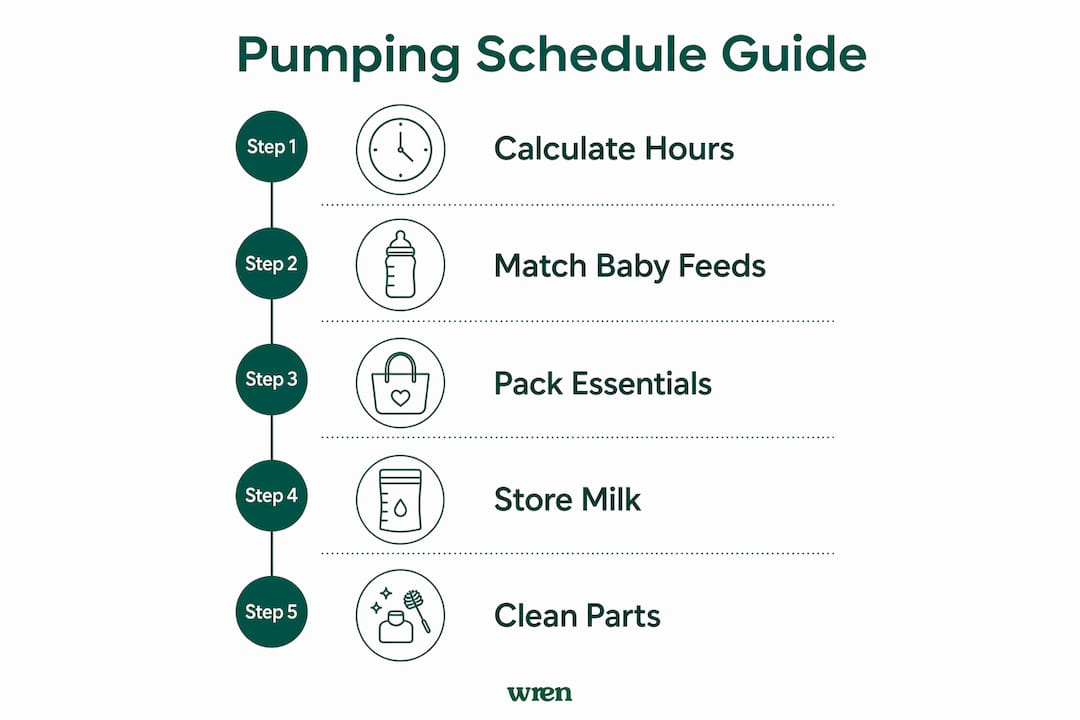
For workplace planning, the My-wren guide to returning to work covers break scheduling and employer conversations in detail.
What to pack in your pump bag for expressing away from home
The core kit covers five categories: the pump itself, power, storage, spares, and cleaning. A well-packed pumping bag includes the pump, power cord or battery pack, a manual pump as backup, extra pump parts, milk storage bags or bottles, labels, a pumping bra, and a cleaning kit.
Packing by trip length:
- Short outing (under 4 hours): Pump, one set of parts, two storage bags, a small cool bag with one gel pack, hand sanitiser, a pumping bra.
- Full day (8–12 hours): Everything above plus a spare set of valves and membranes, a wet/dry bag, three to four storage bags, two gel packs, a bottle brush, and soap or steriliser wipes.
- Overnight or multi-day: Add a second full set of pump parts, microwave steriliser bags, a travel adaptor, and a larger insulated bag.
A few organisation tips worth knowing: keep used parts in the wet side of your wet/dry bag and clean parts on the dry side. Label every bag of milk with the date and time expressed, and store milk in single-feed portions so you only defrost what you need. A hands-free pumping bra folds flat and takes up almost no space.
For a wearable option that removes the need for a separate pumping bra, a Hands-Free Electric Breast Pump sits inside your bra cup and needs no external bottles or tubing during the session. The Hands-Free Double Electric Breast Pumps work the same way for both sides simultaneously, cutting session time significantly. Both are worth considering when space and discretion matter.
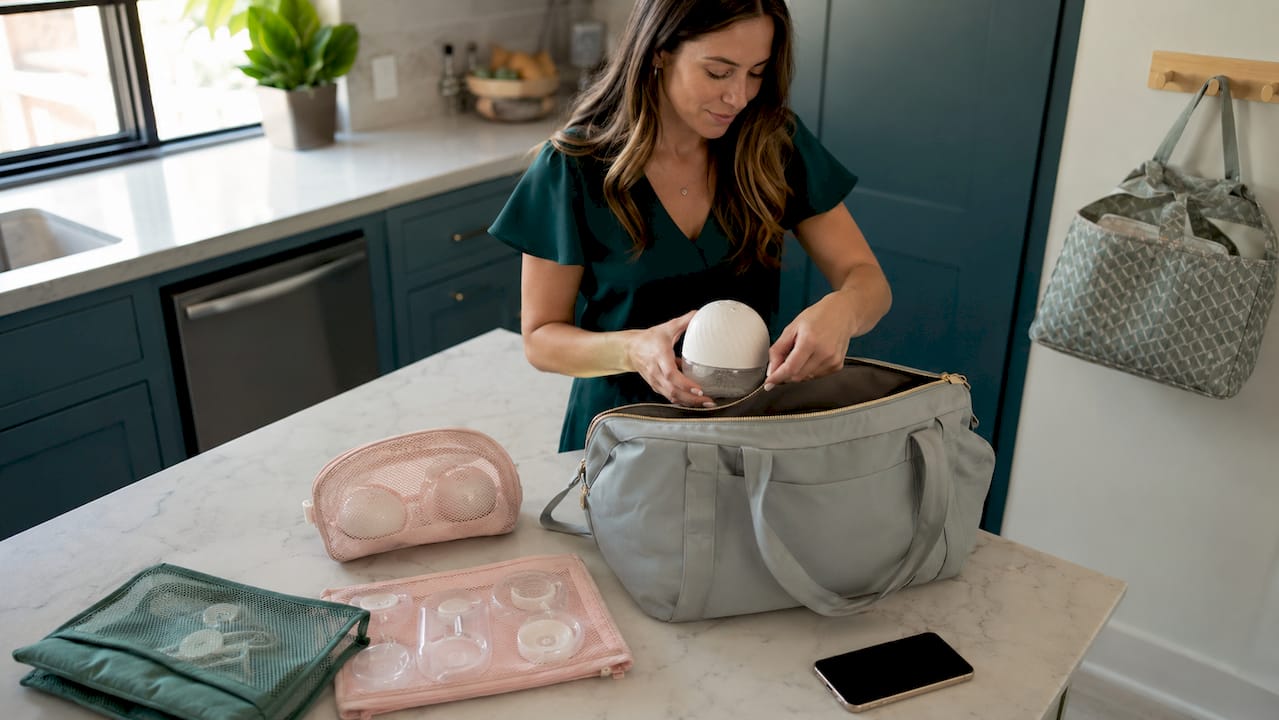
Experienced travellers treat a manual pump as low-cost insurance. Battery failures and delays happen; a compact manual pump means you never miss a session because of a flat charge.
How to store and transport breast milk safely while travelling
Put expressed milk into a cool bag with frozen gel packs immediately after pumping. Transfer it to a fridge or freezer as soon as you reach your destination. The table below reflects guidance on storage times for expressed breast milk.
| Storage location | Safe storage time | Notes |
|---|---|---|
| Room temperature | Up to 4 hours | Cooler room extends this slightly; use sooner if warm |
| Cool bag with frozen gel packs | Up to 24 hours | Keep lid closed; replace packs if they thaw |
| Refrigerator (4°C or below) | Up to 4 days | Store at the back, not the door |
| Freezer (below 0°C) | Up to 6 months | Use oldest milk first |
Three practical scenarios:
4-hour outing: Express into a storage bag, seal it, and place it in your cool bag immediately. At this duration, room temperature is technically safe for up to 4 hours, but a cool bag is always the better choice. Refrigerate when you get home.
Full day (8–12 hours): You will pump two to four times. Keep all expressed milk in the cool bag with fresh gel packs for up to 24 hours. If you have access to a workplace fridge, transfer milk there between sessions and move it to your cool bag for the journey home. Refrigerate on arrival.
Overnight stay: Freeze milk at your destination if you have freezer access. If not, keep it in the cool bag for up to 24 hours and refrigerate or freeze the moment you return. Never top up a warm bag of milk with freshly expressed milk; cool the new milk first.
Label every bag with the date, time, and volume. Use the oldest milk first. Do not mix milk expressed on different days in the same container.
Flying with a pump and milk: tips for UK travellers
You can carry breast milk and a breast pump through airport security. Breast milk is treated as a medically necessary liquid, so the standard 100ml liquid rule does not apply to it. Airports and security services generally ask travellers to declare breast milk and allow extra time for screening. Always check your specific airline and departure airport policy before you travel, as procedures vary.
At UK airport security: Declare your breast milk before placing bags on the belt. Security staff may test the liquid. Frozen gel packs are usually permitted but may be inspected. Arrive at least 30 minutes earlier than you normally would to allow for this. If you need a private space to pump at the airport, ask at the information desk for the nearest parent room or family facility. Most major UK airports have dedicated rooms.
Practical packing for flight day:
- Keep your cool bag and pump in your hand luggage, not checked baggage.
- Carry a battery-powered or wearable pump so you are not dependent on in-seat power.
- Pack a travel adaptor if you are connecting through airports with different socket types.
- Bring spare batteries or a fully charged power bank.
- Use sealed, leak-proof storage bags to prevent spills if cabin pressure changes.
For long-haul flights, plan to pump in the aircraft toilet or ask a flight attendant whether there is a quieter area available. A wearable pump that fits inside your bra is the most discreet option for in-flight use.
Cleaning pump parts when you are away from home
When you cannot wash parts fully, use a validated quick-clean method and keep used parts separate until you can sterilise properly. When soap and water are not available, use an alcohol-based hand sanitiser with at least 60% alcohol before handling pump parts. You do not need to wash your breasts before pumping.
Quick-clean routine (between sessions, limited facilities):
- Rinse parts with clean, cold water immediately after use to remove milk residue.
- If a sink is available, wash with washing-up liquid and warm water, then rinse thoroughly.
- If no sink is available, wipe parts with a purpose-made pump cleaning wipe.
- Place used parts in the wet compartment of your wet/dry bag, sealed.
- Keep them separate from clean parts until you can do a full wash.
Full clean (when you have access to soap, warm water, and sterilising equipment):
Wash all parts in hot, soapy water, rinse well, and either air-dry on a clean surface or use a microwave steriliser bag. Steriliser bags are compact, reusable, and work in any hotel or office microwave.
Pro Tip: Carry a spare set of valves and membranes in a small zip-lock bag. If a part fails or you cannot clean between sessions, you can switch to the fresh set and clean the used set later. This prevents a missed session.
A wet/dry bag is one of the most useful items in any pump kit. The dry side holds clean parts; the wet side contains used ones. It takes up almost no space and removes any guesswork about what is clean.
Where can you pump in public, and what are your rights in the UK?
You are entitled to reasonable breaks to express milk at work. The ACAS guidance on breastfeeding at work advises employers to provide a private, clean space for expressing, and the Health and Safety Executive recommends a suitable rest area for breastfeeding mothers. These are not legally mandated paid breaks in every case, but refusing reasonable requests can constitute indirect discrimination under the Equality Act 2010.
Know your rights: Under the Equality Act 2010, breastfeeding is protected as a characteristic associated with sex. Employers who refuse reasonable break requests or fail to provide a suitable space risk indirect discrimination claims. For specific advice, contact ACAS on 0300 123 1100 or visit acas.org.uk.
Finding a space when you are out:
- Most large shopping centres, airports, and railway stations have dedicated parent rooms with seating and power sockets.
- Use the Changing Places website or your destination’s website to locate facilities in advance.
- Many high-street retailers and cafés will direct you to a private area if you ask.
- At hotels, ask reception for a quiet room or use your own room between check-in and check-out.
At work, a straightforward conversation with your line manager or HR is usually enough. Ask for a specific room (not a toilet), a consistent break time, and somewhere to store expressed milk safely. Most employers are accommodating when the request is clear and practical.
How often should you pump when you are out?
Pump roughly at the times your baby would normally feed. For a newborn, that typically means every 2–3 hours. As your baby grows and feeds less often, you can reduce sessions accordingly. Pumping as often as your baby normally feeds helps your body maintain the right volume.
Common scenarios:
- Typical workday (8 hours): Three sessions, roughly at 10am, 1pm, and 3:30pm, fits most standard working patterns. Adjust to match your baby’s actual feed times.
- Travel day (6–10 hours in transit): Two to three sessions. Use a wearable pump during quieter stretches of the journey. Prioritise sessions if you feel full or uncomfortable.
- Overnight away: Four to five sessions across the day and one session overnight, timed to match when your baby would normally wake. Skipping the night session risks a supply dip.
If something goes wrong:
- Skipped session: Pump as soon as you can. One missed session rarely affects supply long-term, but repeated skips will.
- Engorgement: Express enough to relieve discomfort, even if you cannot do a full session.
- Supply concerns after returning home: Increase feeding or pumping frequency for a few days. If supply does not recover within a week, contact an IBCLC or your NHS midwife or health visitor.
For a detailed pumping schedule, Wren’s guide to breast pumping covers exclusive pumping routines and supply management in depth.
How to encourage let-down when you are away from your baby
Using sensory cues before and during a session is the most reliable way to trigger let-down in an unfamiliar place. Photos, the smell of your baby’s clothing, or a recording of your baby can stimulate the oxytocin response that releases milk. Start the pump on a gentle, stimulation setting rather than full suction.
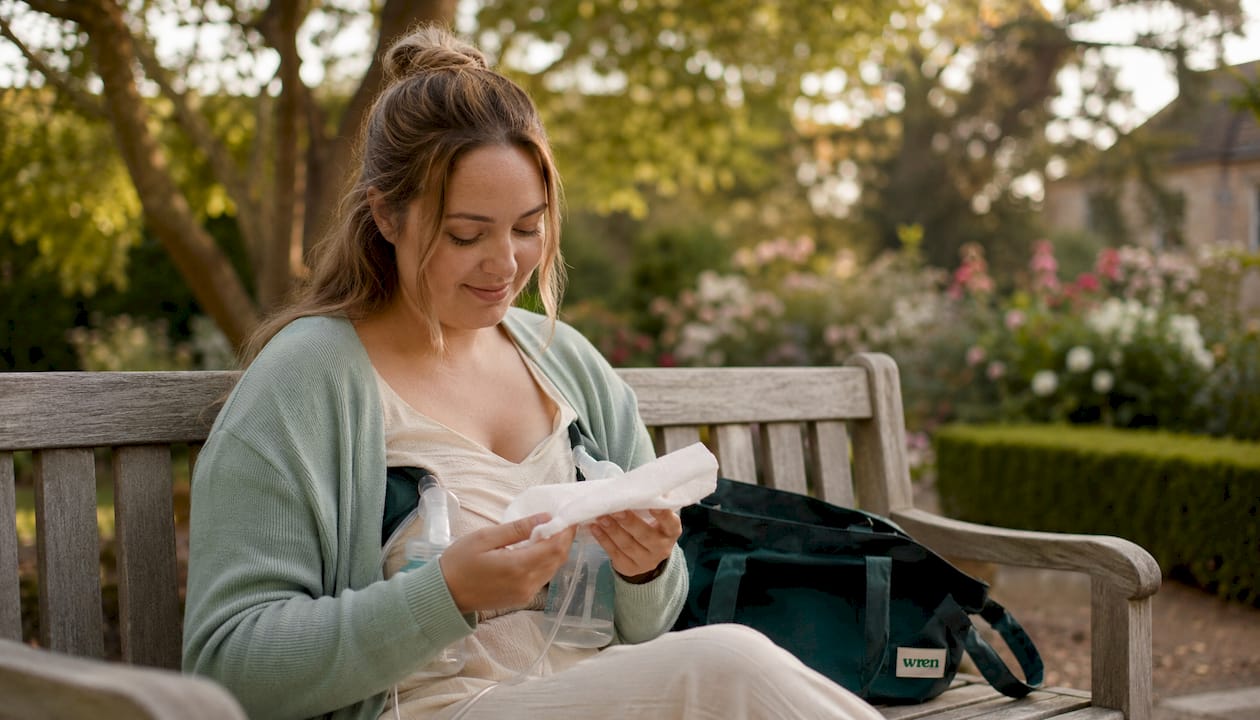
Hand-expressing for 1–2 minutes before switching on the pump often improves milk flow and helps with complete drainage. It is a small step that makes a noticeable difference, particularly in stressful environments.
Practical comfort tips:
- Wear a supportive, well-fitting pumping bra so you are not holding flanges in place throughout the session.
- Apply a warm flannel or heat pad to your breast for a minute before starting.
- Sit upright with your back supported; leaning slightly forward helps milk flow toward the flange.
- Stay hydrated and have a snack nearby. Dehydration reduces milk volume noticeably.
- If you find a particular location stressful, try closing your eyes and focusing on your baby rather than your surroundings.
Pro Tip: Keep a small muslin or worn vest from your baby in your pump bag. The familiar scent is one of the most effective let-down triggers recommended by lactation consultants, and it takes up no space at all.
For broader wellbeing support while travelling with a baby, the beach day survival guide for mums covers comfort and practical care in outdoor settings.
If let-down problems persist across multiple sessions despite sensory cues and relaxation techniques, speak to an IBCLC. Persistent difficulty can sometimes indicate a latch or supply issue that is easier to resolve with professional support.
How to choose a travel-friendly pump
Prioritise hands-free operation, battery life, ease of cleaning, and flange fit. A wearable pump that sits inside your bra removes the need for external bottles and tubing during the session, which matters when you are in a meeting, on a train, or in a parent room with limited time.
Electric pumps are faster than manual pumps, and double electric pumps collect more milk in less time. Double pumping also raises prolactin stimulation, which can help sustain supply when you are away from your baby for extended periods.
Key features to evaluate:
- Weight and size: A pump you will actually carry needs to be light. Wearable pumps that fit inside a bra cup are the most portable option.
- Battery life: Look for a pump that lasts through at least two to three full sessions on a single charge.
- Single vs double pumping: Double pumping halves session time and increases stimulation. Worth the extra cost if you pump frequently.
- Noise level: A quieter pump is more discreet in offices, meeting rooms, or public spaces.
- Flange fit: Correct flange size affects both comfort and milk output. Check sizing guides before buying.
- Spare parts availability: Valves and membranes wear out. Choose a pump with readily available replacement parts.
- Warranty and support: Check what is covered and for how long.
My-wren’s Hands-Free Electric Breast Pump is designed for single wearable use, fitting discreetly inside a bra with no external tubing. The Hands-Free Double Electric Breast Pumps offers simultaneous double pumping in the same wearable format, cutting session time for mothers who pump multiple times a day. Both are battery-powered and suited to travel, work, and everyday use.
For budget guidance, check the product pages directly for current prices in £. Breastfeeding bundles that combine a pump with spare parts and storage accessories are available at My-wren breastfeeding bundles, which can reduce the overall cost of building a complete kit.
Key takeaways
Pumping away from home is manageable when you match your schedule to your baby’s feeds, pack a complete kit, and keep milk cold from the moment it is expressed.
| Point | Details |
|---|---|
| Match sessions to feeds | Pump frequently, with sessions often spaced a few hours apart for a newborn, or whenever your baby would normally feed, to protect supply. |
| Pack the five essentials | Pump, power, cool bag with gel packs, storage bags, spare parts, and a cleaning kit cover every scenario. |
| Keep milk cold immediately | Place expressed milk in a cool bag with frozen gel packs straight away; it is safe for up to 24 hours in a well-packed cooler, then transfer to a fridge as soon as possible. |
| Use sensory cues for let-down | A photo, your baby’s scent, or a short hand-expression before pumping reliably triggers milk flow away from home. |
| My-wren wearable pumps | The Hands-Free Electric and Double Electric Breast Pumps are battery-powered, discreet, and built for travel and work. |
The reality of pumping away from home
The biggest barrier most mothers face is not logistics. It is the expectation that pumping away from baby should feel natural straight away. It rarely does, and that is worth saying plainly.
Let-down in an unfamiliar environment takes practice. The first session in a new location is almost always slower than at home. That is not a supply problem; it is a stress response. The sensory techniques covered in this guide, particularly the scent cue and hand-expression before pumping, exist precisely because lactation experts know the environment affects output. Using them consistently makes a real difference over time.
The other thing that gets underestimated is the value of a spare parts kit. A failed valve or a cracked membrane can end a session entirely. Carrying a second set of valves and membranes costs very little and removes one of the most common causes of a missed pump. It is the kind of preparation that experienced pumping mothers mention repeatedly, and it is easy to overlook until the first time it matters.
The planning steps in this guide, from scheduling sessions to packing the right bag, are not about perfection. They are about reducing the number of decisions you need to make in the moment, so that pumping while out becomes a routine rather than a problem to solve each time.
Wren wearable pumps: a discreet option for expressing on the move
For mothers who want the most discreet, hands-free option for expressing away from home, My-wren’s wearable breast pumps are built specifically for that purpose.
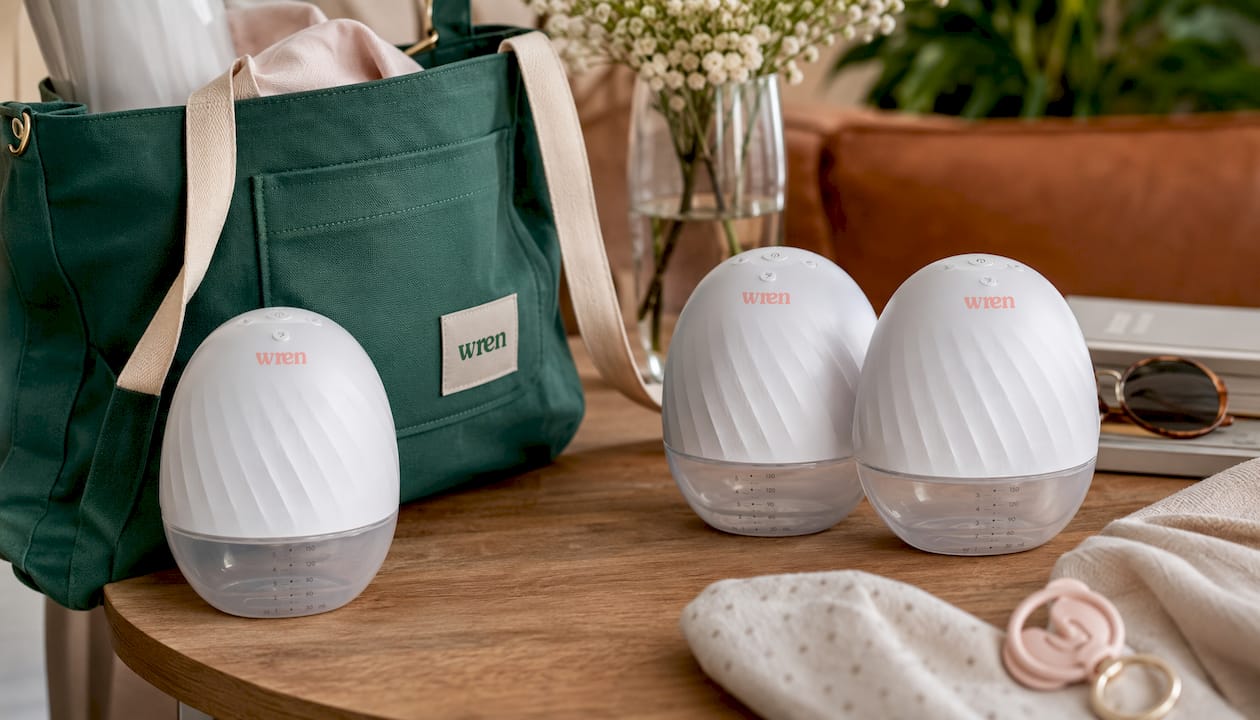
The Hands-Free Electric Breast Pump fits inside your bra cup with no external tubing, runs on battery, and is quiet enough for office use. The Hands-Free Double Electric Breast Pumps does the same for both sides simultaneously, cutting session time for mothers who pump three or more times a day. Both pumps are lightweight, travel-ready, and come with spare parts available separately so you can maintain a full backup kit.
Visit the product pages for current prices in £, full battery specifications, and compatible accessories. For a complete kit, the breastfeeding accessories collection includes storage bags, pumping bras, and cleaning essentials that pair directly with both pumps.
Useful sources and further reading
- NHS: Expressing breast milk — Storage times, hygiene guidance, and step-by-step expressing advice for UK mothers.
- La Leche League International: Pumping milk — Frequency guidance, double pumping benefits, and hand-expression technique from an international lactation support organisation.
- CDC: Travel recommendations for nursing mothers — Practical advice on expressing, storing, and transporting milk while travelling, including security and transport considerations.
- CDC: Pumping breast milk — Guidance on pump frequency, supply maintenance, and when to seek lactation support.
- Office on Women’s Health: Pumping and storing breast milk — Temperature and time storage rules, hand hygiene, and sensory let-down techniques.
- ACAS: Breastfeeding at work — UK workplace rights for breastfeeding mothers, including break entitlements and employer obligations under the Equality Act 2010.
- My-wren: Wren’s guide to breast pumping — In-depth schedules, exclusive pumping routines, and supply management guidance.


