


How many baby clothes do new parents actually need?


Buy 12 to 15 pieces in newborn size and 20 to 25 pieces in 0 to 3 months, and you will have enough to cover the early weeks without drowning in unworn babygrows. That is the short answer. The longer answer depends on how often you plan to do laundry and how fast your baby grows out of each size, both of which vary more than most checklists admit.
For the hospital bag and first fortnight at home, aim for:
- 5 to 6 bodysuits or vests
- 4 to 5 sleepsuits (footed, zip or popper fastening)
- 3 to 4 pairs of socks or scratch mittens
- 2 hats (one lightweight, one warmer depending on season)
- 1 to 2 going-home outfits
These counts assume two to three outfit changes a day and a wash roughly every two to three days. Newborns leak, posset, and grow out of sizes within weeks, so this list is deliberately lean rather than exhaustive.
Key Takeaways
A newborn wardrobe of 12 to 15 pieces in newborn size plus 20 to 25 pieces in 0 to 3 months covers most laundry routines without overbuying.
| Point | Details |
|---|---|
| Buy less in newborn size | Stock only 4 to 6 onesies and 3 to 4 sleepsuits in NB since many babies outgrow it within weeks. |
| Match counts to laundry cycle | Washing every 2 days needs 6 to 8 bodysuits; every 3 days needs 9 to 12. |
| Ignore rigid online rules | The “3-3-3” and “5-3-3” rules are not official standards; tailor counts to your own routine instead. |
| Choose practical fastenings | Side-snap bodysuits and zip-front sleepsuits speed up newborn changes and nappy access. |
| Build your wardrobe with My-wren | Shop organic cotton baby clothes and complementary breastfeeding accessories designed for the early weeks. |
Table of Contents
- How many newborn clothes do I need for the starter wardrobe?
- How many baby outfits should you buy per size?
- Does the ‘3-3-3’ baby clothes rule actually work?
- How does season and growth speed change your baby clothes quantity?
- Which baby clothes are fine secondhand, and which should be new?
- How do you tailor your baby clothes checklist to your own routine?
- What I’d tell a friend buying for the first time
- Starter clothing and feeding essentials worth adding to your basket
- Frequently asked questions
- Sources
How many newborn clothes do I need for the starter wardrobe?
The starter wardrobe is not the same as the hospital bag, though the two overlap. Think of the hospital bag as the bare minimum for the first 48 hours, and the starter wardrobe as what you actually stock at home for the first two to four weeks before the next size change.
Pack light for hospital. You will not need a full wardrobe on the ward. A couple of newborn sleepsuits, one going-home outfit in 0 to 3 months (many babies arrive bigger than expected), a hat, and a blanket cover it. The NHS checklist for newborn essentials is a reliable baseline if you are unsure what counts as genuinely essential versus nice to have.
At home, the starter wardrobe needs more depth because laundry does not happen on demand with a newborn in the house. Look for envelope necklines and side-snap or kimono-style bodysuits, since these avoid pulling anything over a wobbly newborn head. Zip-front sleepsuits also beat poppers for three in the morning nappy changes, a point NHS guidance on dressing a newborn makes clearly.
If you are choosing fabrics, prioritise soft, breathable materials such as OEKO-TEX or GOTS certified cotton, since newborn skin reacts quickly to synthetic blends and rough seams.
How many baby outfits should you buy per size?
This is where most parents overspend, usually on newborn size, which many babies wear for a matter of weeks before moving up.
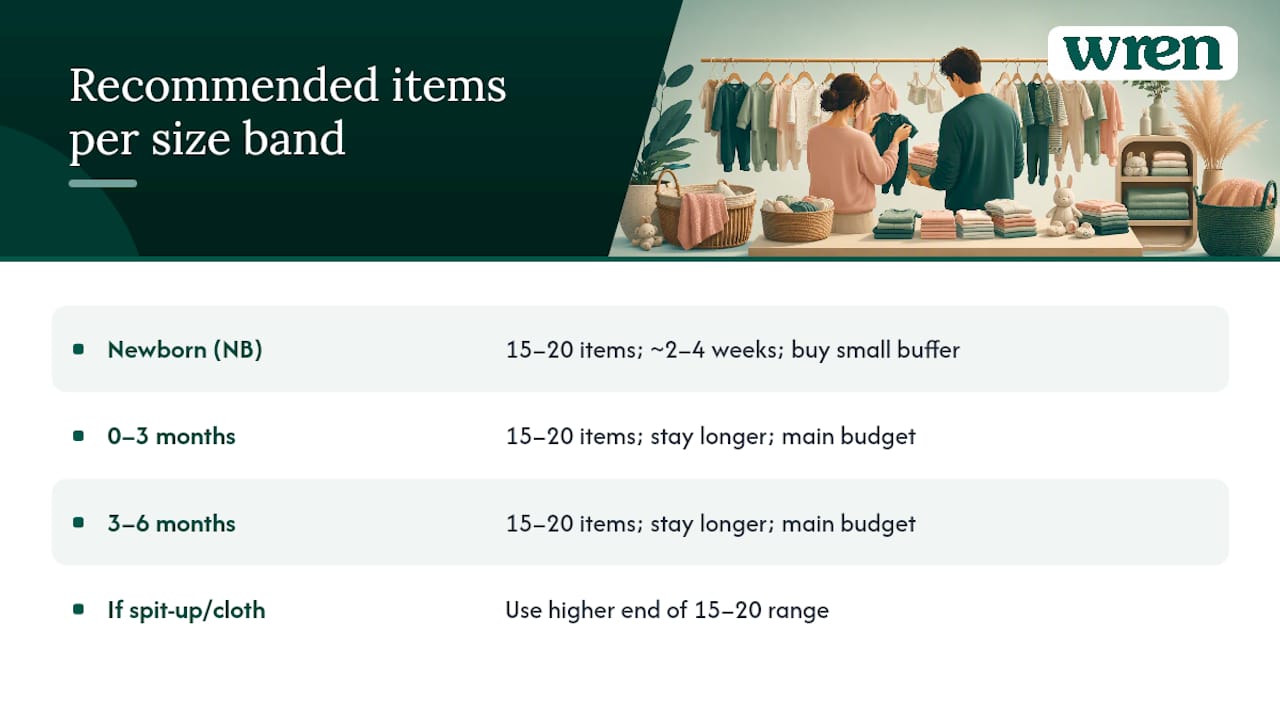
Buying heavily into newborn (NB) is the single most common mistake on baby registries. Growth rates vary wildly between babies, but it is common enough for infants to move out of NB clothing within two to four weeks that stocking a full wardrobe in that size is a genuine risk of waste. Buy a small buffer in NB, then put your real budget into 0 to 3 and 3 to 6 months, where babies tend to stay longer.
A practical newborn wardrobe of around 15 to 20 items per size band is a fair midpoint across most guidance, though heavy spit-uppers or babies in cloth nappies will sit at the higher end of these ranges.
Pro Tip: Choose kimono-style or side-snap bodysuits and zip-front sleepsuits over poppers for the first month. They matter more than they sound. Newborns cannot hold their heads steady, and pulling fabric over a fragile head or fresh umbilical stump is fiddly at 3am. Side-fastening garments open flat, so dressing and nappy changes take half the time.
Does the ‘3-3-3’ baby clothes rule actually work?
You have probably seen it on Pinterest or in a Reddit thread: buy three onesies, three sleepsuits, three outfits per size, or the slightly more generous “5-3-3” version. Neither is an official standard. There is no industry-recognised 3-3-3 or 5-3-3 rule; it is shorthand that spread through parenting forums because it is memorable, not because it is calibrated to how often you actually do laundry.
The number that matters is your washing cycle, not a catchy rule of thumb. Work backwards from how often you can realistically wash and dry a load:
- Washing every 2 days: 6 to 8 bodysuits and 4 to 6 sleepsuits give you a comfortable rotation with a spare day’s buffer.
- Washing every 3 days: bump that to 9 to 12 bodysuits and 6 to 8 sleepsuits, since you are stretching the same items further.
- Washing daily (common with a washing machine at home and a newborn who spits up often): 4 to 5 bodysuits can suffice, though most parents still prefer a small buffer for unexpected days.
Pro Tip: If you expect heavy spit-up, reflux, or you are using cloth nappies with more frequent leaks, add two to four extra bodysuits and sleepsuits to whatever number you land on. Parents sharing a laundrette or washing machine with housemates should do the same, since a missed laundry day hits much harder without a private machine at home.
How does season and growth speed change your baby clothes quantity?
Growth rate is unpredictable, and season adds a second variable most checklists ignore. A baby born in October needs a completely different early wardrobe from one born in June, even at identical ages.
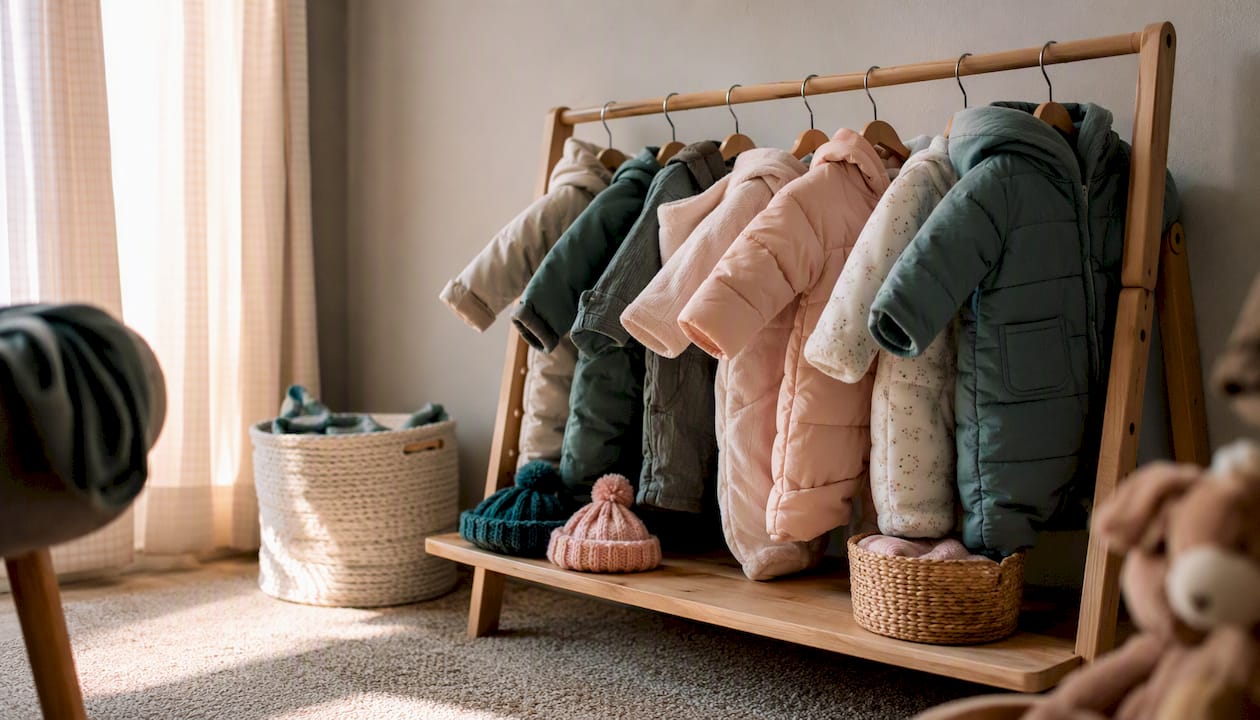
Layer thin, not thick, when it comes to car seats and prams. Bulky snowsuits and padded coats stop a harness from tightening properly in a crash, so the safer approach is a thin base layer, a jumper, then a blanket placed over the buckled harness once your baby is strapped in.
For seasonal buying, go one size up on coats, snowsuits, and all-in-ones rather than buying to current measurements, since outerwear gets worn for months rather than weeks. Hold off on swimwear or heavy coats until closer to when you will actually need them. Retail sizing runs generously in some ranges and tightly in others, so a “6 to 9 months” jacket bought in January might not fit by the time summer or winter actually arrives.
- Buy summer rompers and sun hats close to the season, not months ahead
- Choose mid-weight sleepsuits for a nursery kept around 16 to 20°C rather than the heaviest “winter” option
- Check the tog rating on any sleeping bag or swaddle to avoid overheating, a genuine safety concern alongside layering advice
Which baby clothes are fine secondhand, and which should be new?
Secondhand clothing is one of the easiest ways to cut costs on a wardrobe your baby will outgrow in weeks. Bodysuits, sleepsuits, hats, jumpers, and coats are generally fine secondhand as long as they pass a basic safety check.
Look for intact poppers or zips, no loose buttons or embellishments that could come away, and no lingering mildew or smoke smell that a wash will not shift. Avoid secondhand car seats and anything labelled single-use, and buy sleeping bags or mattresses new, since wear and hidden damage are harder to spot on sleep products than on daywear.
Two quick wins worth knowing: newborn shoes are unnecessary since babies who cannot walk do not need them, and heavy padded outerwear should never go under a car seat harness regardless of whether it was bought new or secondhand.
How do you tailor your baby clothes checklist to your own routine?
No checklist fits every household. A few practical adjustments make the numbers above genuinely useful rather than generic.
- Formula-fed babies often need slightly fewer bodysuit changes than breastfed babies with frequent reflux, though this varies baby to baby.
- Heavy spit-up or reflux: add roughly 20 to 30% more bodysuits and sleepsuits to your baseline count.
- No easy laundry access (shared machine, laundrette trips, small flat with limited drying space): add 2 to 4 extra bodysuits and sleepsuits as a buffer against missed wash days.
- Multiple children in nappies or a small washing machine: lean towards the higher end of every size range above.
Pro Tip: Keep a labelled box for outgrown clothing as soon as items stop fitting, sorted by size, so you can pass them to friends, donate them, or hand them down to a sibling later without a last-minute sort-through. Hold off on buying the next size up until your current one is genuinely snug rather than buying “just in case”.
What I’d tell a friend buying for the first time
Buy less than you think you need, then top up once you know your baby’s actual growth pattern and how quickly you burn through laundry. Every parent I have spoken to who overbought did it out of anxiety, not planning, and ended up with drawers of unworn 0 to 3 months items because their baby jumped straight to 3 to 6. A compact, well-chosen starter set beats a bulging wardrobe every time.
My-wren spends a lot of time around new mums navigating exactly this kind of early decision, from feeding routines to what actually earns a place in the newborn drawer. If you want more of this practical, no-nonsense approach to early parenthood, the My-wren blog covers the rest of the essentials worth knowing before your baby arrives.
Starter clothing and feeding essentials worth adding to your basket
Getting the clothing count right is only half the job. The other half is having the right feeding kit ready before you are exhausted and shopping at 2am.
My-wren’s organic cotton baby clothes collection is built around exactly the fastenings this article recommends: soft, breathable fabric with envelope necklines and popper or zip access for fast changes. Rather than guessing quantities item by item, a small curated set covers the newborn stage without the excess. On the feeding side, if you are planning to express at any point, the hands-free electric breast pump and its double pump equivalent are designed to fit around a newborn’s unpredictable feeding schedule rather than tying you to a chair. Pair either with the bamboo reusable breast pads for everyday comfort, or browse the full breastfeeding accessories collection for everything from flanges to storage. Prices across the range sit from around £15 for accessories to over £100 for pumps, with full delivery and returns details listed at checkout. Start with the baby clothes collection and build your basket from there.
Frequently asked questions
How many baby clothes do I actually need for a newborn? Around 12 to 15 items in newborn size, weighted towards bodysuits and sleepsuits, is enough to cover the first two to four weeks before your baby moves into 0 to 3 months.
How many outfits should I buy in 0 to 3 months? Aim for 20 to 25 pieces across bodysuits, sleepsuits, and trousers, since most babies spend longer in this size than in newborn.
Is the 3-3-3 rule for baby clothes real? No. It is a popular forum shorthand rather than an official standard, and it does not account for your washing frequency or your baby’s growth rate.
Should I buy baby clothes secondhand? Daywear like bodysuits, sleepsuits, and coats are generally fine secondhand if fastenings are intact and there is no odour or damage. Buy sleep products and car seats new.
How much baby clothing should I buy before the baby arrives? Cover newborn and 0 to 3 months before the birth, then buy 3 to 6 months and beyond once you can see how quickly your baby is growing.
Sources
- What you’ll need for your baby
- How Many Newborn Baby Clothes Do I Need (and in What Sizes)?
- Newborn clothing essentials: complete checklist for 2026 | Babysential


