


Breastfeeding at work UK law: what mothers need to know


You are protected under health and safety law and the Equality Act 2010, but there is no automatic statutory right to paid breastfeeding breaks. Your employer must carry out a specific risk assessment once you tell them you are breastfeeding, and must provide suitable rest facilities, never a toilet, once that notification is made.
The trigger for all of this is you, in writing. Before you return to work:
- Tell your employer, in writing, that you are breastfeeding
- Ask for an individual risk assessment
- Request details of rest facilities and milk storage
Quick contact list: the Health and Safety Executive (HSE) covers risk assessments, ACAS handles workplace disputes and early conciliation, the Equality and Human Rights Commission (EHRC) covers discrimination, and Maternity Action offers specialist advice on your specific case.
Key Takeaways
Breastfeeding at work is protected through health and safety law and the Equality Act 2010, and a written notification to your employer is what activates both.
| Point | Details |
|---|---|
| Notify in writing first | This single step triggers your employer’s duty to carry out an individual risk assessment. |
| Toilets are never suitable | HSE guidance is explicit that rest facilities must be private, hygienic, and include milk storage. |
| No paid break entitlement, but strong protections | Refusing reasonable adjustments can still amount to indirect sex discrimination. |
| Escalate through ACAS before a tribunal | Early conciliation is often required and resolves most disputes without a hearing. |
| The right kit supports the routine | My-wren’s wearable pumps and bundles make employer-agreed expressing schedules easier to sustain daily. |
Where to get further help
- HSE: risk assessments and workplace safety duties
- ACAS: early conciliation and dispute resolution
- EHRC: discrimination guidance and your legal protections
- Maternity Action: specialist advisers for individual cases
- NHS: practical guidance on managing the return to work
Table of Contents
- What employers must do under HSE and gov.uk guidance
- Does the Equality Act protect breastfeeding parents?
- What should you do before returning to work?
- What can you do if your employer refuses adjustments?
- What counts as a suitable place to express milk?
- What workplace hazards affect breastfeeding, and what adjustments help?
- How can you make expressing at work easier day to day?
- Practical kit that makes expressing at work easier
- Frequently asked questions
- Sources
What employers must do under HSE and gov.uk guidance
Once you have notified your employer that you’re breastfeeding, a general workplace risk assessment is no longer enough. HSE guidance requires an individual assessment specific to you, covering your role, your hours, and any hazards that might affect you or your milk supply.
That assessment should lead somewhere practical. A suitable rest facility needs to be private and hygienic, with somewhere to store expressed milk, such as a dedicated fridge, and somewhere to lie down if your health needs it. HSE guidance is explicit that toilets do not meet this standard, no matter how clean the workplace insists they are.
Where the job itself poses a hazard, such as shift patterns that clash with feeding times or exposure to substances that could affect breastfeeding, employers have three options:
- Adjust working conditions or hours to remove the risk
- Offer suitable alternative work on the same terms
- Suspend the employee on full pay if no safe alternative exists
None of these are gestures of goodwill. They sit within the Workplace (Health, Safety and Welfare) Regulations 1992 and the Employment Rights Act 1996, which means an employer who ignores them is not just being unhelpful, they may be breaching a statutory duty.
A telling gap: many employers assume that because there’s no legal right to a paid pumping break, they have no obligations at all. That assumption is wrong, and it’s one of the most common reasons breastfeeding parents end up in dispute with HR departments who simply haven’t read the guidance.
Does the Equality Act protect breastfeeding parents?
Yes, though not always directly. The Equality Act 2010 protects against direct sex discrimination, which covers being treated less favourably specifically because you’re breastfeeding, such as being denied a role or demoted for asking to express milk at work.
Indirect discrimination is subtler and more common. It happens when a policy applies to everyone but disadvantages breastfeeding parents unfairly, and the employer can’t justify it. Refusing a shift change that would let you express at reasonable intervals, or telling you to use a toilet cubicle because there’s “nowhere else”, are both classic examples that EHRC guidance flags as risky ground for employers.
- Direct discrimination: refusing to reinstate someone after maternity leave because they’re breastfeeding
- Indirect discrimination: a blanket “no exceptions” shift policy that makes expressing impossible
- Harassment: mocking or pressuring an employee about expressing milk
Case law backs this up. In Mellor v The MFG Academy, an employment tribunal found that forcing a mother into unsuitable conditions to express milk amounted to unlawful treatment, reinforcing that this isn’t a grey area employers can quietly ignore.
Tribunals have already shown they will treat being forced to express in a toilet, car, or similarly inadequate space as more than an inconvenience. It can constitute harassment or discrimination under the Equality Act, and employers who assume otherwise are exposed.
EHRC guidance is unambiguous that failing to assess risk or make reasonable adjustments can itself become grounds for a claim, separate from any single bad interaction.
What should you do before returning to work?
A clear paper trail protects you and helps your employer act correctly, so start before your first day back.
- Send written notification that you are breastfeeding, ideally two to three weeks before your return date
- Request an individual risk assessment in the same message
- Ask specifically about rest facilities, storage, and any hazards in your role
- Discuss shift patterns or hours that might need adjusting
- Identify, with your manager, a realistic space for expressing before day one
A short sample notice might read: “I am writing to confirm that I will be breastfeeding when I return to work on [date]. Under HSE guidance, I would like to request an individual risk assessment and to discuss suitable rest facilities, including somewhere private to express and store milk. I’d welcome a conversation before my return to agree on the details.”
Pro Tip: Loop in occupational health early if your workplace has an occupational health team, or a union rep if you’re a member. A written record from occupational health carries weight if things later become disputed, and a union rep can help you word requests in a way HR is used to processing quickly.
Treat the first conversation as planning, not confrontation. Most delays happen because nobody flagged the need early enough, not because employers are refusing outright.
What can you do if your employer refuses adjustments?
Escalation works best in stages, and most disputes resolve before reaching a tribunal.
- Re-raise the issue with HR or occupational health, referencing your original written notice
- Use your employer’s formal grievance procedure if informal requests go nowhere
- Contact ACAS for early conciliation, which is often a required step before a tribunal claim
- Consider an employment tribunal claim if conciliation fails, noting that strict time limits apply
Keep a written record from the start. Save every email, note the date of your original written notification, keep a copy of any risk assessment (or the lack of one), and jot down details of relevant conversations while they’re still fresh.
- ACAS: early conciliation and general workplace dispute advice
- Citizens Advice: general guidance on your rights and next steps
- Maternity Action: specialist advisers and, where needed, referral to employment lawyers
- EHRC: guidance specifically on discrimination claims
Tribunal time limits are tight, generally three months less one day from the incident, so don’t wait to seek advice if talks stall.
What counts as a suitable place to express milk?
“Suitable” has a fairly concrete meaning in HSE guidance, even though the word sounds vague on paper. It means a private, lockable space with access to washing facilities and somewhere cold to store milk, such as a small dedicated fridge.
It doesn’t have to be a purpose-built room. A first-aid room, an unused meeting room, or a partitioned corner of an office with a power socket nearby can all work, provided they’re private and not a walkway everyone passes through.
Do:
- Ask for a fridge, even a small dedicated one
- Suggest specific rooms that already exist in the building
- Request a lock or a “do not disturb” sign for the door
Don’t:
- Accept a toilet cubicle as an answer, ever
- Settle for a space with no privacy from colleagues or windows
- Assume there’s “nowhere available” without asking HR to check properly
If your workplace has a first-aid room, start there. It usually already has the privacy, cleanliness, and lock that other spaces lack.
What workplace hazards affect breastfeeding, and what adjustments help?
Risk assessments should specifically flag exposure to lead, radioactive materials, organic mercury compounds, and certain other chemicals, alongside less obvious risks like long shifts, night work, or heavy travel demands.
Reasonable adjustments tend to be practical rather than dramatic:
- Altered shift patterns or reduced night work
- Temporary redeployment to lower-risk duties
- More frequent rest breaks to manage supply and comfort
- Guaranteed access to water and washing facilities
Where none of this removes the risk, suspension on full pay becomes the fallback, not a punishment, but a legal safety net while a longer-term solution is found.
How can you make expressing at work easier day to day?
Preparation before your return date matters more than most new mums expect. Practise expressing at home first, so you know your timing and can troubleshoot kit issues away from a work deadline.
- Trial your pump and storage routine at home before day one
- Pack compact, quiet equipment and enough storage bags for a full shift
- Use an insulated cool bag with ice packs if there’s no fridge access yet
- Build pumping into your existing scheduled breaks where possible
A wearable pump genuinely changes the daily logistics here, letting you express with far less disruption to your desk or your day.
Pro Tip: Do at least one full “dress rehearsal” the week before you return, pumping in your actual work clothes. It sounds unnecessary until you discover your blouse doesn’t allow easy access and you’ve got three days to sort it, not three hours.
A common pattern worth naming
Most managers I’ve seen described in workplace guidance aren’t hostile to breastfeeding requests, they’re simply unfamiliar with them. Nobody’s trained them on rest facility rules or risk assessments, so the first conversation often stalls from confusion rather than resistance.
Framing your request as a practical solution, rather than a demand, tends to move things faster. Suggesting a specific room, a specific storage option, or a specific shift tweak gives a manager something concrete to say yes to, and most will.
Practical kit that makes expressing at work easier
Once your employer has agreed to a rest space and a schedule, the right kit is what makes the actual routine work day after day. My-wren’s hands-free double electric breast pumps are designed for exactly this: quiet enough to use discreetly in a shared office, and hands-free enough that you can keep answering emails while you express.
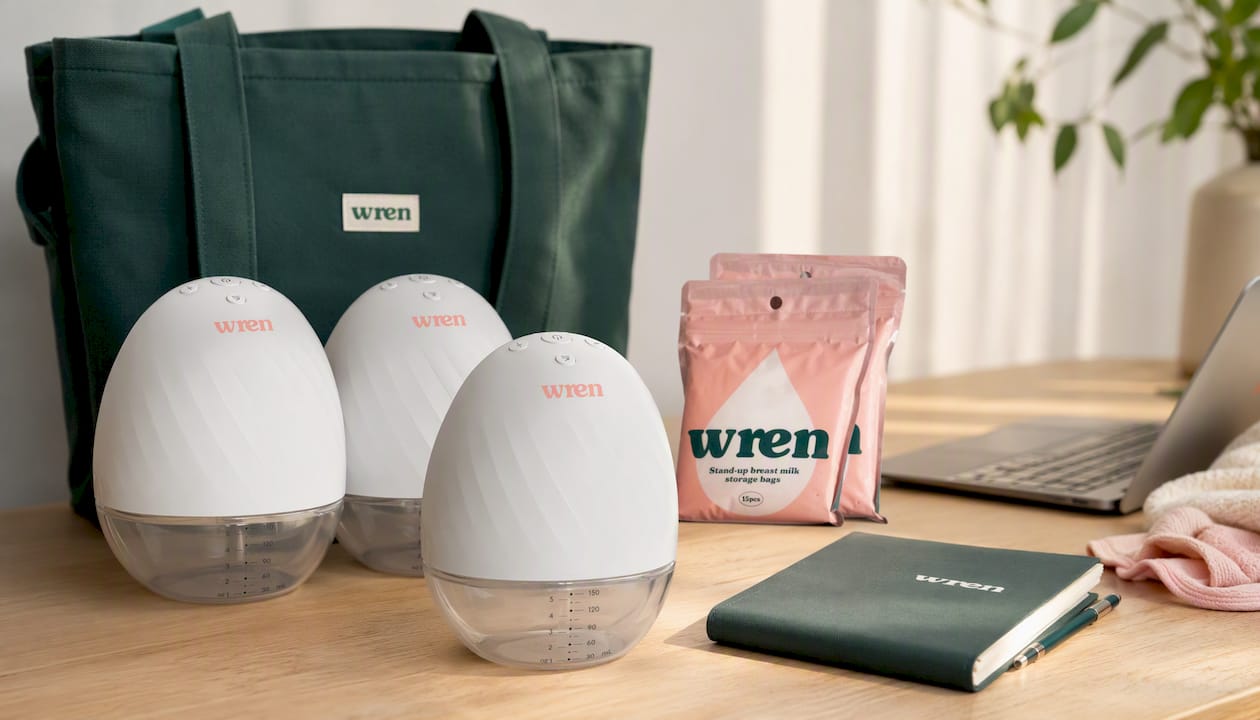
For a full return-to-work setup, the breastfeeding kits and bundles pair a pump with the accessories that solve the small daily headaches, such as reusable breast pads for unexpected leaks and cool storage for milk between sessions. None of this replaces your legal rights. Your employer’s duty to provide suitable facilities and a proper risk assessment stands regardless of what kit you use, but the right pump makes the routine your employer agrees to actually workable in practice. Browse the full range of award-winning breast pumps to find the fit that suits your working day.
Frequently asked questions
Is breastfeeding at work protected by UK law? Yes, through a combination of health and safety law and the Equality Act 2010, though there’s no standalone statutory right to paid pumping breaks.
Do I have to tell my employer I’m breastfeeding? You should, in writing, because that notification is what legally triggers your employer’s duty to carry out a risk assessment and arrange suitable facilities.
Can my employer make me express milk in a toilet? No. HSE guidance explicitly rules out toilets as suitable, and tribunals have treated being forced into inadequate spaces as discrimination or harassment.
What if my employer refuses to make any adjustments? Raise a formal grievance first, then contact ACAS for early conciliation, which is usually required before an employment tribunal claim can proceed.
Are breastfeeding breaks paid? There’s no automatic statutory right to paid breaks specifically for breastfeeding, though many employers do offer them, and refusing all flexibility can risk an indirect discrimination claim.
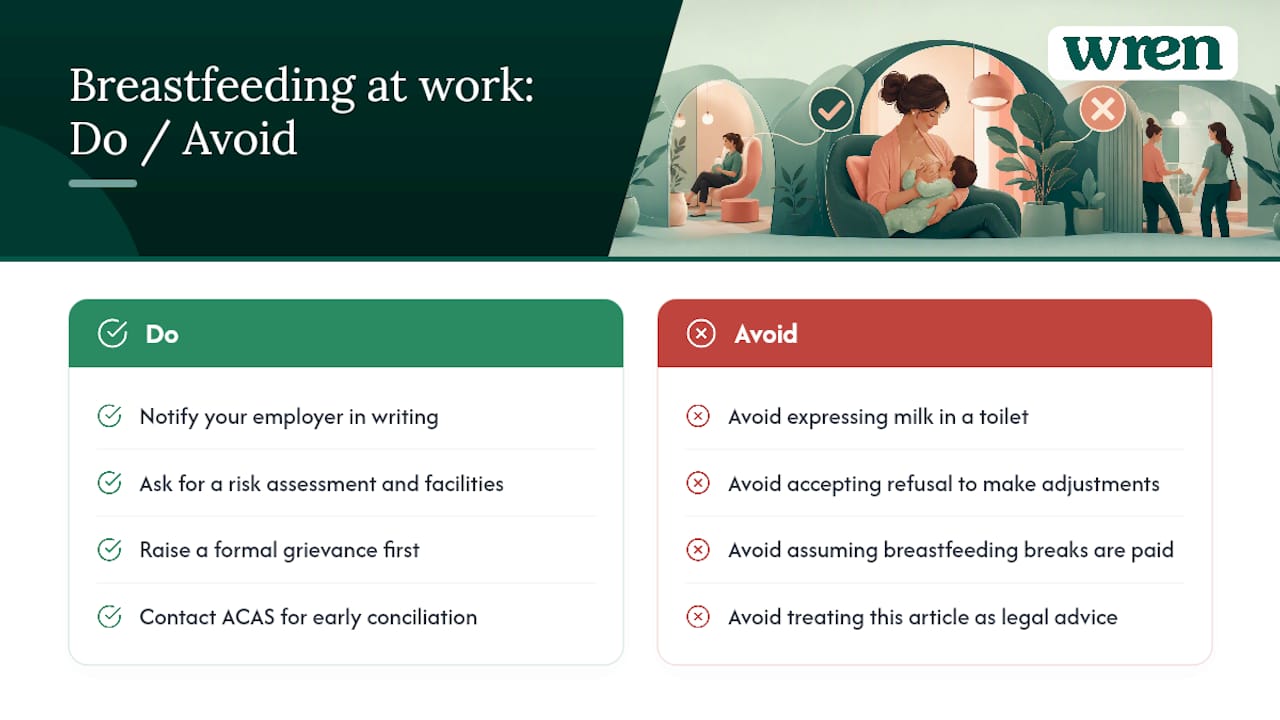
This article is general information, not a substitute for advice from a qualified lawyer. Consult a qualified legal professional about your own circumstances before acting on anything here.
Sources
- Workplace safety law - HSE
- New and expectant mothers at work: Your health and safety - HSE
- Continuing to breastfeed when you return to work - Maternity Action


