


How to recognise low milk supply signs in your baby


The most reliable low milk supply signs are not about how your breasts feel or how much you pump. They are about your baby: weight trajectory, wet nappies, stool output, and visible swallowing during feeds. If your baby has fewer than six wet nappies in 24 hours by day five, has not regained birth weight by 10–14 days, or seems persistently lethargic and unsettled after feeds, act promptly.
Immediate steps to take now:
- Count wet nappies every 24 hours from day one.
- Watch for audible swallowing during feeds.
- Offer skin-to-skin contact to stimulate feeding cues.
- Feed on demand frequently throughout the day.
- Contact your midwife or health visitor if nappies drop below six by day five.
- Call your GP or go to A&E if your baby shows signs of dehydration (sunken fontanelle, no tears, dry mouth, very dark urine).
UK help contacts: your community midwife, health visitor, GP, an International Board Certified Lactation Consultant (IBCLC), or La Leche League GB (0345 120 2918).
Pro Tip: Keep a simple feeding log from day one: time of feed, which side, duration, and nappy output. Three days of data gives any professional a clear picture and speeds up assessment.
Key takeaways
Wet nappies, weight gain trajectory, and audible swallowing are the most reliable indicators of adequate milk supply; pump output alone is not.
| Point | Details |
|---|---|
| Six wet nappies by day five | Fewer than six wet nappies per 24 hours after day five is the clearest early warning sign to act on. |
| Birth weight regained by 10–14 days | Failure to regain birth weight by this point warrants prompt professional assessment. |
| Pump output is not supply | Babies typically remove more milk than a pump; base your assessment on baby behaviour and growth, not pump volumes. |
| Feed frequently and effectively | Frequent feeds per 24 hours, with a correct latch, is the primary way to protect and build supply. |
| My-wren supports your expressing routine | My-wren’s hands-free double electric pump and breastfeeding accessories help maintain frequent, comfortable expressing sessions. |
Table of Contents
- How do you know if your baby is getting enough milk?
- What are the signs that milk supply may be low?
- What causes low milk supply?
- How to increase milk supply: practical steps to try today
- Why pumped volumes can mislead you about your supply
- When should you seek professional help?
- An editorial perspective on supply anxiety
- What My-wren offers mothers managing supply concerns
- Sources
How do you know if your baby is getting enough milk?
The clearest indicators are objective and measurable. NHS guidance lists rhythmic sucking with audible swallows, breasts feeling softer after feeds, a content baby between feeds, and nappies increasing to around six wet nappies per 24 hours by day five as the key signs a baby is feeding well.
Nappy and stool milestones
| Day | Wet nappies expected | Stool colour and consistency |
|---|---|---|
| Day 1 | 1–2 | Black, tarry meconium |
| Day 2 | 2–3 | Dark green/brown |
| Day 3–4 | 3–4 | Greenish-yellow, transitional |
| Day 5 onwards | 6 or more | Yellow, loose, seedy |
Stool frequency drops naturally after the first few weeks. Some breastfed babies go several days between stools once supply is established, which is normal as long as nappies remain wet and weight gain is on track.
Weight gain timeline
By 10–14 days, most should have regained birth weight; failure to do so is one of the clearest reasons to seek prompt assessment. After that, steady weight gain over weeks is expected, though individual variation is normal.
Weight trend matters more than any single measurement. A baby weighed once at a slightly low point can look concerning; the same baby weighed three times over two weeks tells a much more useful story.
Monitoring checklist:
- Weigh at birth, day 5, and day 10–14 at minimum (your midwife or health visitor will arrange this).
- Log every feed: time, side, approximate duration.
- Note audible swallows per feed.
- Count wet and soiled nappies every 24 hours.
- Record any formula top-ups given, including volume.
What are the signs that milk supply may be low?
Distinguishing genuine indicators of insufficient milk from normal newborn behaviour is where most anxiety originates. The table below separates the two.
| Feature | Normal newborn behaviour | Concerning sign |
|---|---|---|
| Feed frequency | frequent feeds per 24 h, cluster feeding in evenings | fewer feeds, baby too sleepy to wake for feeds |
| Feed duration | Varies; around 10 min is typical | Very short feeds with no audible swallowing, or feeds lasting over an hour every time |
| Breast feel | Softer after feeds; less engorged after week 2–3 | No sense of let-down; breasts feel unchanged after feeds |
| Wet nappies | 6 or more by day 5 | Fewer than 6 by day 5; concentrated, dark urine |
| Stools | Yellow and loose by day 4–5 | Still dark/green after day 4; very infrequent with poor weight gain |
| Baby behaviour | Settles between most feeds | Persistent lethargy, weak cry, not waking for feeds |
| Pump output | Variable; does not reflect total supply | Not a reliable indicator on its own |
Specific signs that warrant a call to your midwife or health visitor: fewer than six wet nappies after day five, failure to regain birth weight by 10–14 days, a baby who is difficult to rouse for feeds, or one who feeds for very long periods without appearing satisfied and without audible swallowing.
Common false alarms include cluster feeding (normal, especially in the evenings), breasts feeling softer after the first two to three weeks (a sign supply has regulated, not dropped), and low pump output. Milk production follows a supply-and-demand system, and a pump reading one volume does not mean that is all your baby receives.
Pro Tip: Test-weighing, where a baby is weighed immediately before and after a feed on a precise digital scale, gives a direct measure of milk transfer. Ask your midwife or IBCLC to arrange this rather than relying on pump output alone.
What causes low milk supply?
NICE CKS recommends a full assessment of both mother and infant before diagnosing low supply, because the causes are varied and often reversible.
Mechanical and feeding-related causes:
- Poor latch or attachment, the single most common and most fixable cause.
- Tongue-tie (ankyloglossia), which reduces the baby’s ability to transfer milk effectively.
- Flat or inverted nipples affecting the baby’s ability to draw the breast deeply into the mouth.
- Infrequent feeds or long gaps between feeds, which reduce the demand signal.
- Introducing formula top-ups or dummies before supply is established, which reduces breast stimulation.
- Stopping night feeds too early.
Maternal health factors:
- Thyroid disorders (both hypo- and hyperthyroidism can affect supply).
- Retained placenta or severe postpartum haemorrhage, which can delay or suppress milk coming in.
- Polycystic ovary syndrome (PCOS) and insulin resistance.
- Certain medications, including some hormonal contraceptives and decongestants containing pseudoephedrine.
- Significant stress or anxiety, which can temporarily inhibit the let-down reflex.
Risk factors associated with lower production: research has identified minimal breast growth during pregnancy, advanced maternal age, and gestational diabetes as factors statistically linked to lower milk output. If two or more of these apply to you, early support from an IBCLC is worth requesting proactively rather than waiting for problems to emerge.
If supply does not respond to the practical steps below, ask your GP about thyroid function and prolactin testing. For tongue-tie assessment, ask your midwife for a referral to a tongue-tie practitioner; waiting lists vary by NHS trust.
How to increase milk supply: practical steps to try today
The core principle: frequent, effective milk removal is the primary driver of production. Everything else supports that.
Step-by-step plan:
- Feed on demand frequently throughout the day. Do not watch the clock between feeds; watch your baby’s feeding cues (rooting, hand-to-mouth, stirring).
- Check latch and positioning. A deep latch, where the baby takes a large mouthful of breast tissue, not just the nipple, is the single biggest lever. Ask your midwife or health visitor to observe a feed.
- Offer both breasts at each feed. Switch sides when swallowing slows, then offer the first side again if the baby is still hungry.
- Add hand expression or pumping after feeds. Even five minutes of hand expression after a feed sends an additional demand signal. For tips on increasing supply, the My-wren blog covers practical techniques in detail.
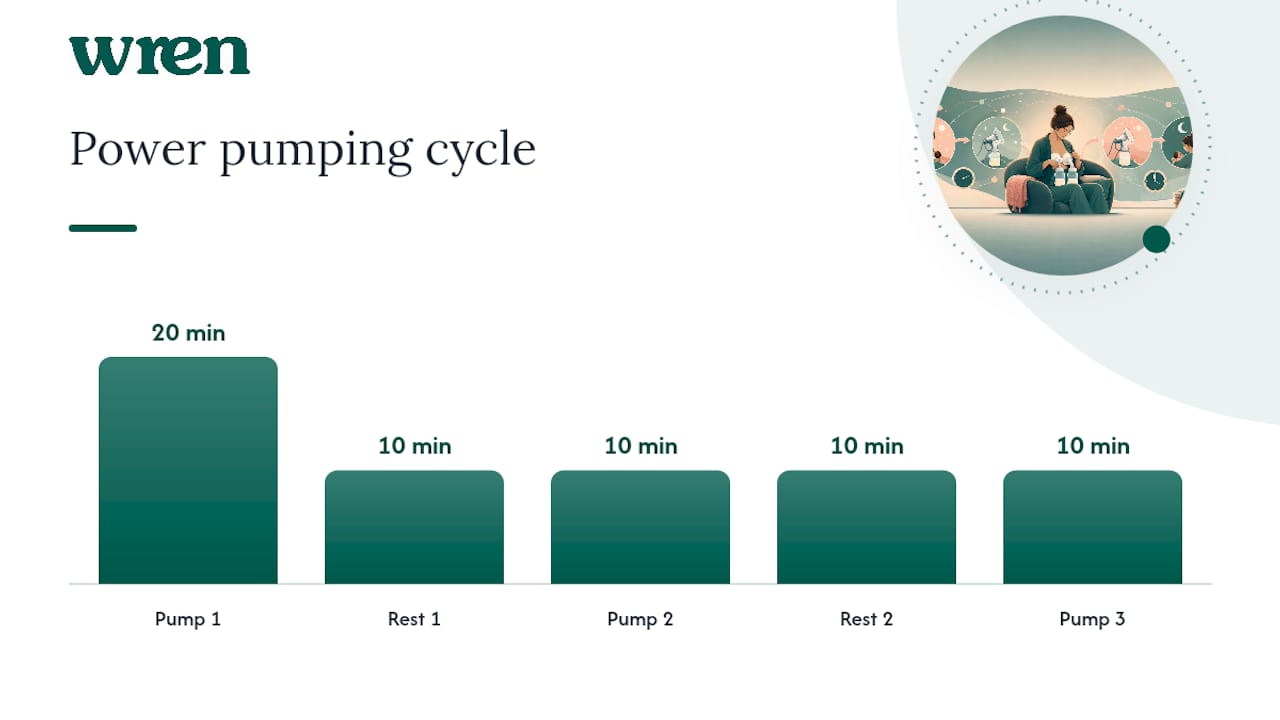
- Try power pumping once daily. Pump for 20 minutes, rest 10, pump 10, rest 10, pump 10. This mimics cluster feeding and can stimulate supply over 48–72 hours.
- Maximise skin-to-skin contact. Skin-to-skin raises oxytocin, which supports let-down and feeding cues, particularly useful in the first two weeks.
- Avoid dummies and formula top-ups unless medically indicated. Both reduce breast stimulation. If top-ups are needed, discuss paced bottle feeding with your midwife to protect supply.
If you are fully pump-dependent (for example, your baby is in neonatal care), aim for eight pump sessions per 24 hours, including at least one overnight session when prolactin levels are naturally higher. A hands-free double electric breast pump makes this schedule more manageable.
On galactagogues: herbal supplements such as fenugreek and prescription medications such as domperidone are sometimes used to support supply. Neither replaces effective milk removal. Discuss any supplement or medication with your GP or IBCLC before starting, particularly if you have existing health conditions. For herbal options, AlkaHerbs provides a range of lactation-support supplements worth reviewing with your prescriber.
Pro Tip: Breastfeeding nutrition matters too. Staying well hydrated and eating enough calories (breastfeeding typically requires an additional 300–500 kcal per day) supports your body’s ability to produce milk.
If supply has not improved after five to seven days of consistent effort, ask your midwife or health visitor for an urgent referral to an IBCLC.
Why pumped volumes can mislead you about your supply
Many mothers conclude their supply is low because they pump small amounts. This is often incorrect. Babies are typically more efficient at removing milk than mechanical pumps, and several factors reduce what a pump collects without reflecting what your baby actually receives.
Factors that reduce pump yield:
- Incorrect flange size (the most common issue; the flange should fit the nipple with 2–3mm of space around it).
- Suction set too high or too low.
- Pumping too soon after a feed, when the breast has less milk available.
- Stress or discomfort during pumping, which inhibits let-down.
- Pump quality and age (older or lower-grade pumps lose suction efficiency).
Simple pump-fit check:
- Look at the flange tunnel during pumping. Your nipple should move freely without the areola being pulled in excessively.
- If the nipple rubs the tunnel sides, the flange is too small. If areola tissue is being drawn in, it may be too large.
- Try adjusting suction to the highest comfortable level, not the maximum setting.
- Pump in a warm, quiet space with a photo of your baby nearby; this genuinely supports let-down.
Hand expression steps:
- Warm the breast with a warm flannel for two to three minutes.
- Place your thumb and fingers in a C-shape around 2–3cm back from the nipple.
- Press gently back towards your chest, then compress and release rhythmically.
- Move around the breast to drain different areas.
Pro Tip: In clinical practice, average daily weight gain of around 26g per day is used as a practical proxy for adequate milk transfer. A growth chart trend over two to three weeks tells you far more than any pump session.
When should you seek professional help?
Self-monitoring is appropriate for a short period, but some signs need professional assessment without delay.
Red flags requiring urgent contact with your midwife, health visitor, or GP:
- Fewer than six wet nappies per 24 hours after day five.
- Baby has not regained birth weight by 10–14 days.
- Signs of dehydration: sunken fontanelle, no tears when crying, dry mouth, very dark or no urine.
- Persistent lethargy, difficulty waking for feeds, or a weak or high-pitched cry.
- Significant weight loss beyond 10% of birth weight at any point.
UK support contacts and what each offers:
- Community midwife: first point of contact in the first 10–28 days; can observe a feed, check weight, and refer.
- Health visitor: takes over after the midwife; can arrange weight checks and refer to specialist support.
- GP: can investigate maternal causes (thyroid, prolactin) and prescribe if indicated.
- IBCLC: specialist lactation assessment including latch observation, test-weighing, and tongue-tie screening.
- La Leche League GB: peer support and telephone helpline (0345 120 2918); early referral to breastfeeding support often resolves feeding problems before they escalate.
- Hospital neonatal team: if your baby was premature or is currently admitted, the neonatal team includes lactation support.
What to bring to any appointment:
- Your feeding log (dates, times, duration, which side).
- Recent weights if you have them.
- A note of nappy output over the last 48 hours.
- Any medications you are taking.
- Pump volumes if you have been expressing.
An editorial perspective on supply anxiety
Most mothers who worry about low supply are not producing too little milk. The worry itself is one of the most common experiences in early breastfeeding, and it is worth naming that clearly.
What tends to happen is this: breasts soften after the first two weeks (normal), the baby feeds more frequently in the evening (normal cluster feeding), and a pump session yields less than expected (a poor proxy for actual supply). These three things together feel alarming. They are usually not.
The genuinely useful signal is the baby: weight trend, nappy output, visible swallowing, and contentment between feeds. Those four things, tracked consistently, give a far clearer picture than breast feel or pump volumes. Practical tools help here. A lactation massager can support milk removal before and during feeds, bamboo reusable breast pads keep you comfortable during frequent feeding, and a nipple bubble offers protection if latch issues are causing soreness. None of these solve a supply problem on their own, but they make the process of feeding more comfortable while you work through the steps above.
Seek help early. A single appointment with an IBCLC or a call to La Leche League can resolve in an hour what weeks of anxious self-monitoring cannot.

What My-wren offers mothers managing supply concerns
Frequent feeding and expressing sessions are physically demanding. My-wren’s hands-free double electric breast pump is designed for mothers who need to maintain an expressing schedule without being tethered to a wall socket, whether that is eight sessions a day in the early weeks or a lunchtime pump at work.

The full breastfeeding accessories range includes bamboo reusable breast pads, a lactation massager, and a nipple bubble with storage case, all designed to support comfort and milk removal during the period when supply is being established. For mothers who want a ready-assembled starting point, the breastfeeding kits and bundles bring the key items together. Browse the range at My-wren and find the products that fit your feeding routine.
Sources
Reliable UK-focused resources for further guidance:
- Breastfeeding: is my baby getting enough milk? - NHS
- Diagnosis of low milk supply - NICE CKS
- Defining low milk supply: A data‑driven diagnostic framework (PMC)
- Low milk supply | Children’s Hospital of Philadelphia
- Is baby getting enough? - La Leche League International
This article provides general information only and is not a substitute for professional medical advice. If you have concerns about your baby’s feeding or weight gain, contact your midwife, health visitor, or GP.


