


Pregnancy journal ideas: prompts and tips to start today


Start with one entry right now: write today’s date, one feeling word, and attach a phone photo. That is a complete first entry. According to BabyCenter, there is no single correct way to keep a pregnancy journal, and simple “I feel…” starters are enough to build a lasting habit. Low friction creates momentum, and that first emotional anchor is often the page you return to most.
To begin, you need three things: a notebook or a phone notes app, a pen, and your phone camera. Nothing else. My-wren’s blog covers practical pregnancy wellness in detail. The same principle applies here: small, consistent actions matter far more than a polished start. If you are already in your second or third trimester, start at your current week and work forward. A half-filled book is still a meaningful keepsake.
Table of Contents
- 40+ pregnancy journal ideas grouped by theme
- Trimester and week-by-week prompt sets you can follow straight away
- What to include in a pregnancy journal: a practical checklist
- Formats and materials: which setup suits your lifestyle?
- How to keep journalling without burning out
- Creative starters and openers you can copy
- Why journalling helps: the evidence behind the habit
- Pregnancy journal and keepsake gift ideas (UK-focused)
- Key takeaways
- Why the journal matters more than the format
- My-wren’s pregnancy and breastfeeding essentials
- Useful sources and further reading
40+ pregnancy journal ideas grouped by theme
These prompts are designed to be copied directly onto a page or used as section headers. Pick one theme per week or mix freely.
Firsts and milestones
- Date I found out I was pregnant and exactly how I felt in that moment
- First positive test photo (stick it in or describe where you were)
- First ultrasound scan: date, week, what the sonographer said
- First time I felt the baby move: time, place, who was with me
- First item of clothing bought for the baby
- Date I told my employer and how that conversation went
Daily micro-entries
- Today’s date, week of pregnancy, and one word for my mood
- What I ate today and whether it stayed down
- One thing that made me laugh this week
- How I slept last night and what woke me
- One worry I have right now, written out plainly
Photos and keepsakes
- Weekly bump photo with week number written on the back
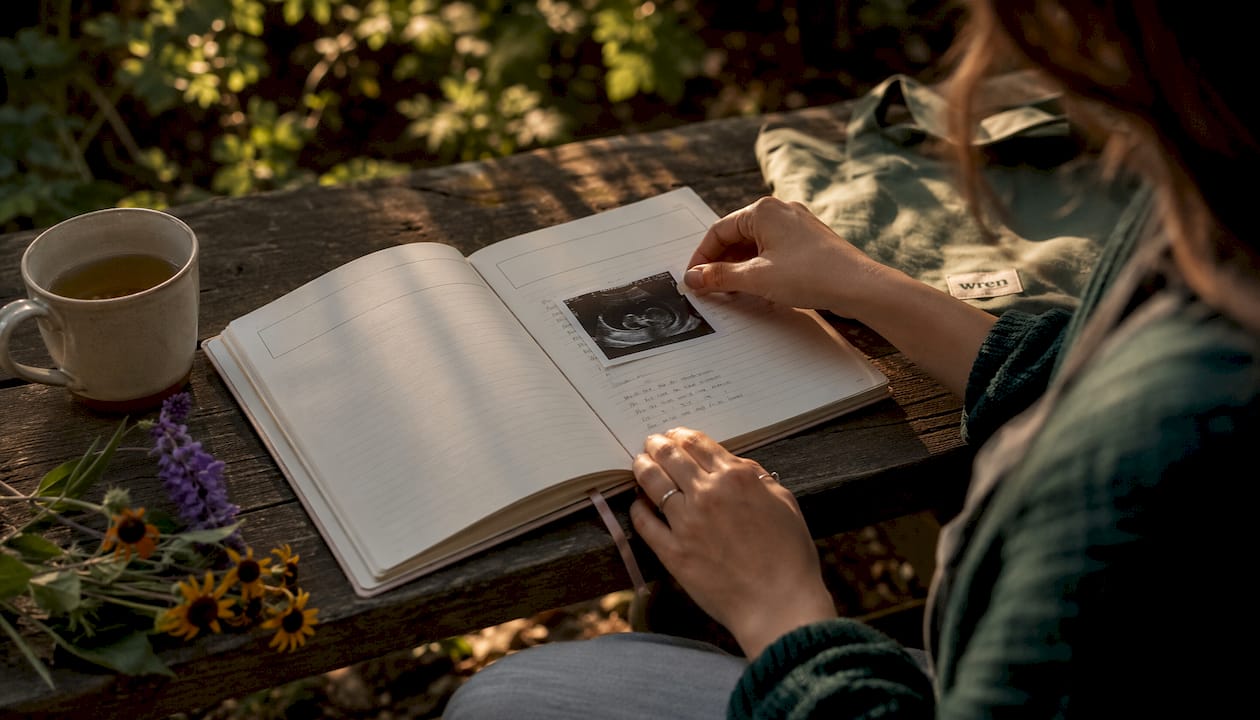
- Ultrasound scan prints (tape or glue in, date and annotate)
- Baby shower invitation, a pressed flower from the table, or a card
- Hospital wristband from any appointments or admissions
- A receipt or ticket stub from a memorable outing during pregnancy
Letters to your baby
- A letter written at 12 weeks: who we are and what we hope for you
- A letter at 20 weeks: what the anomaly scan showed and how we felt
- A letter at 36 weeks: what we have prepared and what still scares us
- A letter written the night before your due date
Medical and planning notes
- Current symptoms by trimester and what helped
- Birth plan outline: preferences, who will be present, key wishes
- Medications and supplements taken (with GP sign-off dates)
- Midwife appointment notes: dates, measurements, questions asked
- Antenatal class dates and the one thing you learnt that surprised you
Fun lists: cravings, dreams, and tiny details
- Full list of food cravings, week by week
- Foods I suddenly cannot stand (and used to love)
- Strangest pregnancy dream, written out in full
- Names we considered and ruled out, with reasons
- Songs I played on repeat during pregnancy
- Nicknames we gave the bump before the name was chosen
Partner and family contributions
- Ask your partner to write one entry per trimester in their own words
- A note from a grandparent-to-be about what they are looking forward to
- Your own parents’ reaction when you told them: their exact words if you can recall them
- A sibling’s drawing or note (if there are older children in the family)
- A short entry from a close friend who was there for a key moment
Pro Tip: Personalise each theme by tucking a physical item into a small envelope glued to the page: a hospital appointment card, a till receipt from the first baby-clothes purchase, or a maternity henna print from a keepsake session.
Trimester and week-by-week prompt sets you can follow straight away
These prompts give you a ready-made schedule. Use one or two lines per week; the goal is a brief emotional note plus one concrete detail. Starting at your current week and working forward is completely fine.
| Week / Stage | Prompt (emotion + concrete detail) |
|---|---|
| Weeks 4–6 | “I found out on [date]. My first feeling was ___ because ___.” |
| Weeks 7–9 | “My biggest symptom this week is ___. I am managing it by ___.” |
| Weeks 10–12 | “Before the 12-week scan I felt ___. Afterwards I felt ___.” |
| Week 13 | “Second trimester begins. One thing that has got easier: ___.” |
| Week 20 | “Anomaly scan week. The one detail I want to remember: ___.” |
| Week 22 | “I felt the baby move properly for the first time on [date]. I was ___.” |
| Weeks 25–28 | “This week I am most looking forward to ___. I am most nervous about ___.” |
| — | “My body feels ___ right now. One thing helping me rest: ___.” |
| Week 36 | “Birth plan drafted. My top priority is ___.” |
| — | “The night before my due date: I feel ___, and I want to remember ___.” |
For late starters: write a single “before you arrived” page that covers the weeks you missed in three or four sentences each. Then continue with the current week’s prompt. The record does not need to be chronologically complete to be worth keeping.
What to include in a pregnancy journal: a practical checklist
A lasting journal combines sentimental keepsakes, practical records, and the small everyday details that are easiest to forget. Standard baby memory guides recommend separating these three categories so the journal is easy to navigate later.
Sentimental keepsakes
- First ultrasound scan print (date and annotate in pen)
- Anomaly scan print at 20 weeks
- Hospital appointment letters or wristbands
- A letter to the baby written at each trimester
- Baby shower card, invitation, or a small pressed flower from the day
- A note written by your partner or a family member
Practical records
- Symptom tracker: week, symptom, severity, what helped
- Birth plan notes: preferences, hospital bag checklist, key contacts
- GP and midwife appointment log: dates, measurements, questions
- Medications and supplements with start dates
- Antenatal class notes and any questions you still have
Everyday details
- Weekly cravings and aversions list
- Recurring pregnancy dreams (even the odd ones)
- One funny or unexpected moment per week
- A note about your daily routine at each trimester: what a typical Tuesday looks like
Media storage tips: store paper keepsakes in small glassine envelopes or washi-tape pockets glued to the page. For photos, print at a local print lab (Boots Photo and Snapfish both offer UK delivery) and use acid-free photo corners rather than glue to prevent yellowing.
Sample entry template:
Date: 14 March | Week: 22 | Mood: Calm but tired Highlight: Felt three clear kicks during the afternoon commute. Keepsake attached: Anomaly scan print from 20-week appointment.
Formats and materials: which setup suits your lifestyle?
Choosing the right format is the single biggest factor in whether a journal gets finished. Digital-first workflows reduce friction considerably: capture a note on your phone, then transfer highlights to a physical book when you have ten minutes.
| Format | Pros | Cons |
|---|---|---|
| Plain notebook | Low cost, fully flexible, easy to personalise | No prompts; blank page can feel daunting |
| Guided pregnancy journal | Prompts built in, structured layout | Less flexibility; may not match your pace |
| Scrapbook / smashbook | Visual, tactile, great for keepsakes | Time-intensive; needs craft supplies |
| Phone notes app (e.g. Apple Notes, Google Keep) | Always to hand, instant capture, searchable | No physical keepsake without printing |
| Dedicated journalling app (e.g. Day One, Penzu) | Organised, photo-friendly, password-protected | Subscription cost; data tied to platform |
| Hybrid (phone capture + physical book) | Best of both: low friction + lasting keepsake | Requires a transfer habit to work |
Quick DIY keepsake journal setup (under £10):
- One A5 hardback notebook (£3–£5 from WHSmith or Ryman)
- A pack of washi tape for borders and pockets (£2–£4)
- Glassine envelopes for scan prints and keepsakes (£2 for a pack of 50)
- A fine-liner pen for annotations
Divide the notebook into three trimester sections using sticky tabs, then add a “letters” section at the back.
Privacy note for digital journals: use a notes app with a passcode lock, back up photos to an encrypted cloud account (iCloud with Advanced Data Protection or Google One with enhanced encryption), and export a PDF to local storage before sharing with family. Avoid storing sensitive medical details in unprotected shared folders.
How to keep journalling without burning out
The most common reason pregnancy journals go unfinished is that they become a separate task on an already full list. Pairing journalling with an existing routine removes that friction entirely.
- Habit stack it: write one line while the kettle boils, during a midwife waiting room wait, or as part of a bedtime wind-down.
- Set a two-minute timer: commit to two minutes only. Most entries run longer once you start, but two minutes is the commitment.
- Use a micro-entry format: date, week, one feeling word, one concrete detail. Four fields. Done.
- Capture on phone, transfer monthly: type a timestamped note whenever something happens (“22 March, week 28: first hiccups felt on the bus”). At the end of each month, pick three favourites and copy them into the physical book.
- Keep the journal visible: a book left on the bedside table gets used; one stored in a drawer does not.
- Skip perfectionism: monthly five-minute updates produce a richer record than occasional long entries written under pressure.
Pro Tip: Capture a timestamped single sentence in your phone whenever a milestone happens, for example: “20 March, week 26: baby kicked three times during the film.” At the end of the month, transfer your three favourite notes into the physical journal. This preserves context and keeps the cognitive load low.

Creative starters and openers you can copy
These exercises are low-pressure. The goal is an honest record, not polished prose.
The ten-word snapshot Describe this moment in exactly ten words. No more, no fewer. Example: “Tired, huge, happy. Pasta again. Kicks at 11pm. Worth it.” The constraint forces specificity and produces entries that read vividly years later.
The letter opener Begin with: “By the time you read this, you will be ___.” Write for five minutes without stopping. Personal letters are consistently listed among the most treasured pages in keepsake journals, both by the parents who wrote them and the children who eventually read them.
The memory map Draw a rough circle in the centre of a page and write one word inside it: a place, a feeling, or a date. Branch outward with connected words or short phrases. No sentences required. This works well for capturing a complicated emotion (the 20-week scan, a difficult appointment) without having to write a linear account.
The list of hopes Write ten things you hope for this child. Number them. Keep each one to a single sentence. Revisit and add to the list at each trimester.
Inviting partner or family contributions Leave a blank page at the end of each trimester with a heading: “A note from [name].” Hand the book over with no further instruction. Unscripted entries from a partner, a parent, or a sibling carry a different voice and add depth a single author cannot replicate. For a more structured approach, write three prompt questions at the top of the page: What are you most looking forward to? What do you want this baby to know about you? What do you hope for them?
Simple page layout: heading at the top (week and date), one paragraph of free writing, one attached photo or keepsake. That structure works for every theme and requires no artistic skill.
Why journalling helps: the evidence behind the habit
Journalling supports emotional self-regulation by giving feelings a name and a place. The mechanism is straightforward: writing about an experience activates the same cognitive processing as talking it through, but at a pace the writer controls. Research published by Cambridge University Press on expressive writing found modest but meaningful reductions in anxiety and depressive symptoms among regular writers. Journalling is not a replacement for clinical support, but it functions well as an adjunct.
“Journalling helps self-regulation and emotional processing by naming fears, joys and expectations — giving them form rather than letting them circulate unexamined.” BabyCenter
Three practical ways to steer entries towards wellbeing:
1. Name the emotion precisely. “Anxious” is a start. “Anxious about the 20-week scan because last time the sonographer paused for a long time” is a complete thought that can be examined, discussed with a midwife, or simply released onto the page.
2. Spot patterns over time. Reading back three weeks of entries often reveals that a recurring worry has either resolved or is tied to a specific trigger (tiredness, a particular day of the week). Patterns are easier to address once they are visible.
3. Use short reflective prompts. End each entry with one sentence: “One thing I am grateful for today: ___.” This is not toxic positivity; it is a deliberate counterweight to the anxieties that pregnancy naturally produces.
My-wren’s blog covers healthy pregnancy habits in practical detail, and the same principle of small, consistent actions applies to journalling as much as to physical wellness.
Pregnancy journal and keepsake gift ideas (UK-focused)
A pregnancy journal makes a thoughtful gift because it is useful from the first trimester and becomes more valuable over time. These options are all available in the UK.
- Guided pregnancy journal (£12–£25): widely available from Waterstones, Amazon UK, and independent bookshops; look for ones with weekly prompt pages and space for scan prints.
- Scrapbook kit (£15–£30): a plain hardback album plus a pack of washi tape, acid-free photo corners, and glassine envelopes; available from Hobbycraft or online.
- Polaroid or instant print bundle (£20–£40): a Fujifilm Instax Mini or a Kodak Step printer with a pack of film; ideal for bump photos that go straight into the journal.
- Keepsake box (£10–£20): a small wooden or fabric-lined box for hospital wristbands, scan prints, and first-trimester mementos; available from Not On The High Street and Etsy UK sellers.
- My-wren baby shower gift collection: My-wren’s baby shower gift range includes practical breastfeeding and pumping essentials that pair well with a journal as a complete new-mother gift set.
Presentation tip: write a short note on the first page of a gifted journal: the date, the occasion, and one sentence about why you chose it. Add a small envelope inside the front cover for the recipient to store their first scan print. That single detail transforms a book into a keepsake from the moment it is opened.
Key takeaways
Starting with one low-effort entry today, choosing a format that fits your daily routine, and using weekly micro-prompts are the three habits most likely to produce a pregnancy journal you will actually finish.
| Point | Details |
|---|---|
| Start with one entry today | Write a date, one feeling word, and attach a photo — that is a complete first entry. |
| Pick a format that fits your life | A hybrid phone-capture-plus-physical-book workflow reduces friction and lowers abandonment. |
| Use weekly micro-prompts | One emotion plus one concrete detail per week produces a rich record without pressure. |
| Include keepsakes and media | Scan prints, letters, and small physical items are consistently the most treasured pages. |
| My-wren supports the full journey | My-wren’s pregnancy collection and blog offer practical guidance alongside products for every stage. |
Why the journal matters more than the format
Most articles about maternity journalling spend a lot of time on aesthetics: the right notebook, the prettiest washi tape, the most photogenic flat lay. That framing quietly sets the wrong expectation. The best journal is the one you finish, and the ones that get finished are almost always the ones with the lowest barrier to entry, not the most beautiful covers.
What actually makes a pregnancy journal valuable years later is specificity and honesty. A single sentence written at 3am about not being able to sleep, with the exact worry named, is worth more than a beautifully formatted weekly spread that took forty minutes and says nothing particular. The cravings list, the funny dream, the exact words your partner said when you told them: those are the details that disappear fastest from memory and matter most when you read them back.
The other thing most guides understate is that journalling during pregnancy is genuinely useful for mental health, not just as a memory tool. Naming a fear on paper reduces its ambient weight. That is not a wellness cliché; it is a well-documented mechanism. The practical implication is that the entries written during the hardest weeks, the ones you are most tempted to skip, are often the most worth writing.
My-wren’s pregnancy and breastfeeding essentials
A pregnancy journal captures the memories. My-wren’s range covers the practical side of the journey alongside it. From the Hands-Free Electric Breast Pump and Hands-Free Double Electric Breast Pumps to smaller essentials like Bamboo Reusable Breast Pads, a Lactation Massager, a Breast Shield 25mm (Flange), and the Nipple Bubble with storage case and bag, every product is designed for comfort and everyday use. All prices are listed in £ on the website, with no hidden costs. Browse the full breastfeeding bundles range or visit My-wren to find the right kit for your stage of pregnancy or postpartum recovery.
Useful sources and further reading
-
BabyCenter — Why journalling is good for you during pregnancy Practical overview of the psychological benefits of pregnancy journalling, with guidance on simple entry formats. Read it here
-
Cambridge University Press — Emotional and physical health benefits of expressive writing Peer-reviewed research on the anxiety and mood effects of regular expressive writing; the primary academic source for wellbeing claims. Read it here
-
Lucy Darling — Pregnancy journal prompts A well-organised prompt list with reassurance for late starters; useful for week-by-week inspiration. Read it here
-
Solstice Stories — Baby journal ideas and prompts Covers letters to the baby, first milestones, and how to invite partner contributions; UK-friendly tone. Read it here
-
Babysential — What to write in your baby book: a complete guide Practical checklist of what to include across pregnancy and the newborn stage; good reference for the keepsakes section. Read it here
-
Dingbats Notebooks — What to write in a baby memory journal Covers low-pressure list formats and monthly update templates; useful for tired mothers who want a minimal approach. Read it here
-
The Baby Spot — 150 pregnancy journal prompts Large prompt library grouped by theme; includes guidance on habit stacking and hybrid digital-physical workflows. Read it here
-
My-wren blog — 10 tips for a healthy and happy pregnancy Practical wellness guidance from My-wren covering routines, nutrition, and self-care during pregnancy. Read it here


