


2L Containers Allowed on UK Flights: Pack, Screen and Pump Hands Free


Yes, you can carry expressed breast milk in your hand luggage on UK flights, even without your baby travelling with you. Each container must hold no more than two litres, and frozen milk cannot go through the cabin, only in hold luggage. Security staff may ask to open or screen containers separately, so pack milk where you can reach it quickly.
TL;DR:
- Expressed breast milk containers up to 2,000 ml are allowed in hand luggage, but frozen milk must travel in hold luggage and cannot go through security cabin screening.
- Clear, resealable bottles or bags are recommended for faster screening, and security may ask to open or test containers, which is routine.
- Airlines and airports may impose practical limits on the total volume, especially for extended trips with large quantities of milk, requiring prior communication.
- Breastfeeding during the flight is protected by law, and crew cannot legally ask you to stop or move seats while feeding your baby.
- Travellers should pack extra ice packs, label all containers, and consider a health professional’s letter for large or special circumstances to ease security checks.
Table of Contents
- What are the UK rules on flying with breast milk?
- What happens at airport security with breast milk?
- How should you pack and store breast milk for travel?
- Can you breastfeed or express on the plane?
- How do you protect your milk supply while travelling?
- Should you tell your airline or airport in advance?
- Do the rules differ for domestic and international UK flights?
- Is a doctor’s letter necessary for carrying breast milk?
- What if your flight is delayed or your luggage goes missing?
- A practical checklist for your travel day
- How My Wren makes flying with breast milk easier
- Sources
What are the UK rules on flying with breast milk?
Gov that applies to most drinks and toiletries in hand luggage. That exemption holds whether or not your baby is on the flight with you, which matters if you’re travelling for work or leaving your baby with a partner while you express to keep your supply going.
The official position breaks down into a few clear rules:
- Expressed breast milk is allowed in hand luggage in containers up to 2,000 ml each.
- Frozen breast milk is not permitted through security in the cabin; it must travel in hold luggage instead.
- There’s no fixed legal cap on how many containers you can bring, though airports and airlines can apply their own practical limits.
- Cooling packs, ice packs and gel packs are permitted to keep milk cold in transit.
Airports generally prefer clear, non-metallic bottles or bags over insulated flasks. Heathrow’s guidance warns that metal or heavily insulated containers can interfere with X-ray screening, which often means extra checks. Because the total-quantity question sits in a grey area between GOV.UK’s baseline and individual airport discretion, it’s worth checking your specific departure airport’s website before you fly, particularly if you’re carrying several days’ worth of milk.
What happens at airport security with breast milk?
Security teams see expressed milk regularly, but a little preparation avoids delays for you and the queue behind you.
- Pack your milk in clear, resealable storage bags or transparent bottles, positioned near the top of your hand luggage rather than buried at the bottom.
- Remove cooling packs and present the milk separately in the tray. Tell the officer plainly: “I’m carrying expressed breast milk.” You don’t need to justify it further.
- Expect a visual check, and sometimes a swab test or a request to open a container. This is routine, not a sign anything’s wrong. If a queue builds or you feel rushed, it’s fine to ask calmly for a supervisor to assist.
Gatwick’s own security pages confirm that individual containers up to two litres can travel in unlimited numbers through the cabin, with frozen milk redirected to hold luggage. Officers are trained to prioritise babies and feeding items, so most checks take under a minute once your milk is clearly labelled and easy to access.
Pro Tip: Keep a spare, empty storage bag in your carry-on. If security opens a container for testing, you can transfer the milk into a fresh bag rather than risk a spill or having to discard it.
How should you pack and store breast milk for travel?
The container you choose matters almost as much as the rule itself. Clear, rigid plastic bottles or dedicated storage bags let security see the contents instantly, which speeds up screening compared with opaque flasks or metal thermoses.
A practical packing checklist:
- Use clear, resealable milk storage bags or transparent bottles, double-sealed where the bag allows it.
- Label every container with your baby’s name (if relevant) and the date expressed, so nothing gets mixed up or used out of order.
- Pack ice packs or reusable gel packs inside an insulated cool bag to hold temperature during the journey.
- If any milk needs to travel frozen, it must go in hold luggage inside a well-insulated cooler, and it’s worth checking your airline’s policy on dry ice or coolant packs beforehand.
- On layovers, build in ten minutes to ask airport customer services about fridge access. Heathrow, for example, lists family service points in most terminals where you can sometimes store milk briefly.
For longer connections, treat the transfer as its own mini-journey: refresh your ice packs, top up any cooling gel, and check the next terminal’s facilities before you land rather than after.
Can you breastfeed or express on the plane?
Breastfeeding on board is protected under the Equality Act, and no member of cabin crew can lawfully ask you to stop or move seats because you’re feeding. If anyone does, it’s worth noting their name and raising it with the airline afterwards.
Practical points for the flight itself:
- An aisle or window seat tends to give more room to manoeuvre than a middle seat, particularly if you’re using a pump.
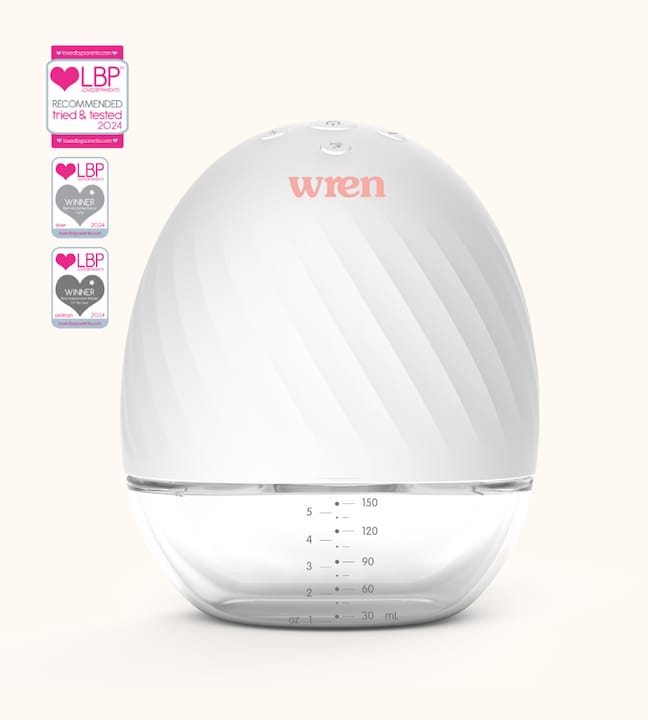
- A wearable pump keeps both hands free, which helps if you’re managing hand luggage, a bassinet, or an older child at the same time.
- The NHS notes that feeding often helps babies settle during take-off and landing, and many UK airports have baby care rooms if you’d rather feed away from your seat.
- Ask crew politely whether they can warm a bottle; not all can, so it’s sensible to bring a manual warming option or plan to feed at room temperature.
Pro Tip: If you’re expressing mid-flight, ask a crew member early about disposing of used ice packs. Some airlines will happily take them, saving you carrying wet packs through arrivals.
How do you protect your milk supply while travelling?
Travel disrupts routine, and routine is what keeps supply steady. NaTHNaC recommends speaking to a health professional four to six weeks before you travel where possible, particularly for longer trips or unfamiliar climates.
Sticking close to your normal expressing schedule matters more than the destination. Skipping sessions to fit an itinerary is one of the fastest routes to engorgement, and from there, to mastitis. If a pump isn’t to hand, hand-expression for a few minutes every three to four hours can hold the gap. Watch for warning signs: a hot, tender patch on the breast, flu-like aches, or a fever. These call for prompt medical advice, not a wait-and-see approach.
Hydration and rest sound obvious, but long-haul cabins are dehydrating, and jet lag disrupts the sleep that supports supply. If a flight forces a longer gap than usual, expect a dip, and know that consistent expressing over the following day or two usually brings it back.
Should you tell your airline or airport in advance?
There’s no legal requirement to notify anyone before flying with breast milk, but a quick heads-up can save time on the day. Contacting your airline’s special assistance team ahead of travel lets them flag your booking, and some will note it so cabin crew are aware without you needing to explain at the gate.
For airport security specifically, most UK airports don’t require advance notice for expressed milk, since it’s a standard, well-understood exception to liquid rules. That said, if you’re travelling with an unusually large volume, perhaps several days’ supply for an extended trip, it’s worth emailing the departure airport’s customer service team first. This is less about permission and more about avoiding a lengthy discussion at the tray point when you’re also managing a baby, a buggy, and hand luggage.
International departures benefit most from this step, since queues tend to run longer and staff may be less familiar with unusual quantities. A short email describing what you’re carrying, roughly how many containers, and whether any is frozen (destined for the hold) gives staff time to prepare rather than pause your queue on the day.
Do the rules differ for domestic and international UK flights?
The core rule stays the same everywhere in the UK: expressed breast milk is allowed in hand luggage, frozen milk isn’t, and the 2,000 ml container limit applies regardless of your destination. What changes is the practical experience around it.
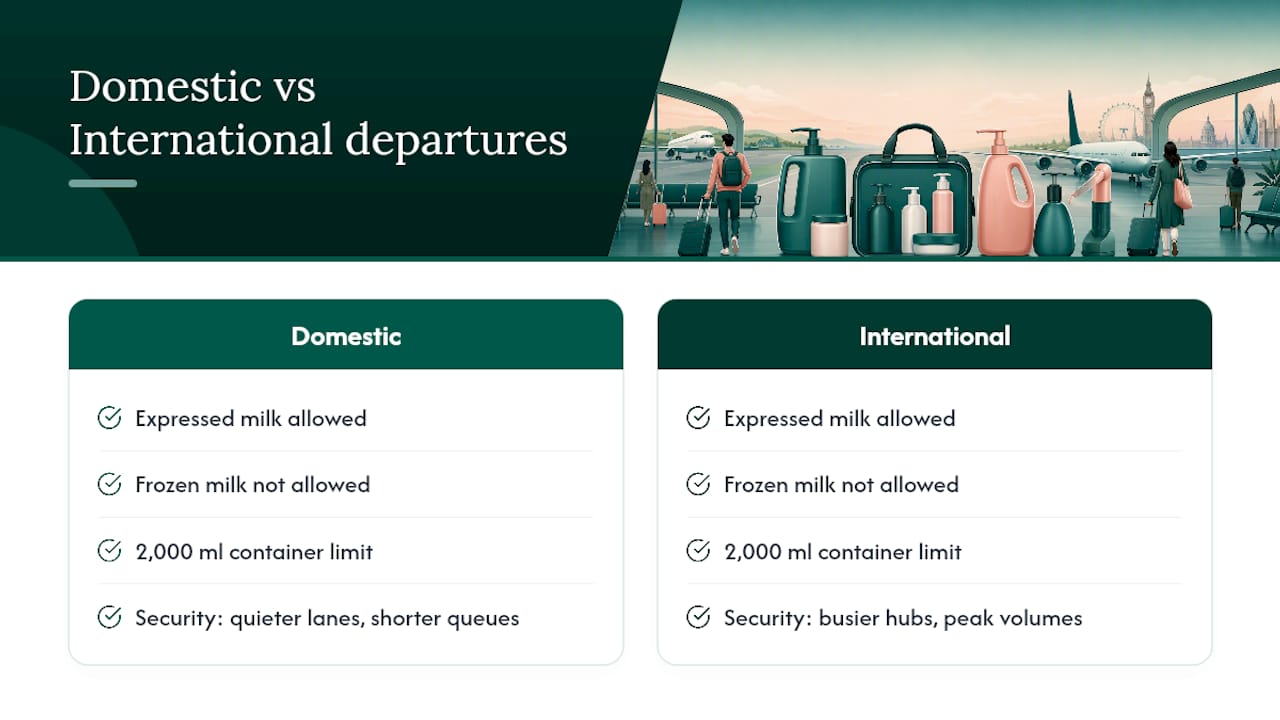
Domestic flights, Edinburgh to London, say, tend to move through smaller, quieter security lanes, so screening staff often have more time to talk you through the process if you’re unsure. Queues are typically shorter, and there’s less pressure if a container needs a second look.
International departures from UK airports, particularly at major hubs during peak summer or holiday periods, involve more security lanes, more staff rotation, and considerably higher volumes of passengers. That doesn’t change what you’re allowed to carry, but it does mean staff may be less able to pause and explain things individually. Building in extra time at security is the practical adjustment, not a different set of rules.
It’s also worth remembering that once you land internationally, the destination country’s own rules on liquids and infant feeding items apply from that point, which may differ from the UK’s approach on your return leg.
Is a doctor’s letter necessary for carrying breast milk?
A supporting letter from a health professional isn’t a legal requirement anywhere in UK aviation rules, and airport security won’t ask for one as standard. Expressed breast milk is already a recognised, well-documented exception to liquid restrictions, so you don’t need paperwork to justify carrying it.
That said, a short letter can be genuinely useful in a couple of specific situations. If you’re carrying an unusually large volume, several litres for an extended international trip, for instance, a brief note from your GP or midwife confirming the milk is for infant feeding can smooth over any questions at an unfamiliar airport, particularly abroad where staff may be less used to UK guidance. It’s also worth having if you have a medical reason for expressing without your baby present, such as a hospital stay or a return to work, since it gives context without you needing to explain your personal circumstances to a stranger in a security queue.
If you do choose to carry one, keep it simple: your name, a note that you’re transporting expressed breast milk for infant feeding, and the healthcare provider’s contact details. There’s no official template, and no airport will refuse you for not having one, but it removes any awkwardness if a query does come up.
What if your flight is delayed or your luggage goes missing?
Delays are the biggest practical threat to a stash of breast milk, since cooling packs only hold their temperature for so long. If you know a delay is coming, ask airport staff early about fridge access; many terminals have family rooms or baby care facilities with fridges, even if they’re not widely advertised.
A few habits reduce the risk before you’re standing at a gate wondering what to do:
- Pack more ice packs than you think you’ll need. A spare pair costs little and buys hours of extra cooling if a flight slips.
- Keep a small stash of formula or ready-to-feed milk as a backup if you’re travelling with your baby, purely as insurance against a long delay.
- If checked luggage carrying frozen milk goes missing, report it immediately at the baggage desk and ask specifically about their cold-chain handling policy. Airlines vary, and a quick claim is easier to resolve than one made days later.
- Photograph your packed milk and cool bag before you check in, so you have a record for any compensation claim if the contents spoil.
Travel disruption is also where travel insurance for pregnancy and postpartum periods earns its keep, since some policies cover the cost of replacing specialist feeding equipment or formula if a delay forces you to buy supplies you hadn’t planned for.
A practical checklist for your travel day
Before anything else, express as close to your departure time as you reasonably can. It tops up your stash and eases the pressure of a long gap ahead. Pack labelled storage bags, not just bottles, since they’re flatter, easier to see through at screening, and take up less space than rigid containers.
Keep your pump and spare parts, an extra set of flanges, valves and pads, in one accessible pouch rather than scattered through your bag. A wearable pump genuinely earns its place here: expressing hands-free while queuing or waiting at the gate keeps supply steady without turning airport downtime into a scheduling problem.
Bring more insulation than feels necessary. A second ice pack has saved more than one traveller’s milk during an unexpected delay.
— Paul
How My Wren makes flying with breast milk easier
My-wren is built for exactly this kind of travel day, where hands-free expressing matters more than usual and every spare part needs to be within reach. The Hands-Free Electric Breast Pump lets you express discreetly under clothing while managing hand luggage, a buggy, or a boarding pass, without needing a private room or a power socket search.
Pack a set of Breast Milk Storage Bags for clear, easy-to-screen containers that fold flat once empty, and keep a spare Breast Shield 25mm (Flange) and Connector Unit in your travel pouch in case a part goes astray mid-journey. If you’re expressing for two or want faster sessions before a long flight, the Hands-Free Double Electric Breast Pumps cut expressing time noticeably. Prices across the range start from around £30 for accessories, up to full pump sets. Browse the full breastfeeding accessories collection and build your travel kit before your next trip.
Sources
- Hand luggage restrictions at UK airports
- Breastfeeding and bottle feeding | NaTHNaC / TravelHealthPro
- Feeding when travelling | Sussex Community NHS


