


Freezing Breast Milk Safely for Parents: Keep Quality for 6 Months


Yes, you can freeze expressed breast milk safely, and it’s one of the most useful things a new parent can learn. Keep it at −18°C or colder for several months at best quality, or for a longer period in a deep freezer running at −20°C or colder. Thaw it in the fridge or under warm water, never in a microwave, and use it within 24 hours once fully defrosted. Store it in sterilised containers or dedicated bags, labelled with the date.
TL;DR:
- Freezing breast milk at −18°C or colder preserves best quality for several months, with up to 12 months acceptable in a deep freezer at −20°C or colder.
- Store milk in sterilized, food-grade containers or breast milk storage bags, leaving about 2.5cm of headspace and labeling each with the date and volume.
- Thaw frozen milk gradually in the fridge overnight or under lukewarm water, never in a microwave, and use within 24 hours of fully thawing.
- Freezing is most beneficial when building a backup supply for future use, supplementing low supply days, or managing excess expressed milk.
- Proper hygiene, quick storage after pumping, and avoiding refreezing thawed milk are essential to maintain safety and nutrients.
Table of Contents
- When should you freeze breast milk instead of refrigerating it?
- What containers and portions work best for freezing?
- How long does frozen breast milk stay good?
- How do you freeze breast milk flat?
- What is the safest way to thaw and warm breast milk?
- How do you keep expressed milk hygienic from pump to freezer?
- How do you transport breast milk safely?
- Why does frozen breast milk sometimes smell or taste different?
- Can you mix fresh milk with frozen or refrigerated milk?
- Paul at Wren: a short practical perspective
- How Wren’s breast milk storage bags can help
- Sources
When should you freeze breast milk instead of refrigerating it?
Most parents start freezing milk for one of three reasons: they’re heading back to work and need a stash ready to go, they want a small safety net for the days when supply dips, or they’ve expressed more than baby needs right now and don’t want to waste it. None of these require an elaborate system, just a bit of forward planning.
Timing matters more than most people expect. Chill or freeze expressed milk within 2 hours of pumping, and sooner if the room is warm, since bacteria multiply faster at higher temperatures. If freezing isn’t happening straight away, get it into the fridge first rather than leaving it out on the side while you decide.
Refrigeration alone is often the better call if you know the milk will be used within a few days. Mayo Clinic’s guidance recommends chilling milk promptly and only freezing it when you don’t expect to use it within that short window, which avoids the slight nutrient changes that come with freezing and thawing.
Freezing tends to make sense when:
- You’re building a back-up supply for nursery, childcare, or a night away.
- You’ve expressed a surplus and want to avoid tipping it down the sink.
- You’re dealing with engorgement and pumping more than baby needs in that sitting.
- You want a buffer for days when pumping output is lower than usual.
What containers and portions work best for freezing?
Not every container in your kitchen cupboard is fit for milk storage. You need something food-grade, clean, and designed to handle the expansion that happens as liquid freezes.
Three options work well: sterilised glass containers, BPA-free food-grade plastic pots, or purpose-made breast milk storage bags. Bags tend to be the most practical for freezing, since they’re designed to lie flat and take up far less freezer space than rigid tubs. Whichever you choose, La Leche League recommends minimising how often you transfer milk between containers, as each transfer risks contamination and loses a little fat content along the way.
Portioning well saves you money and stress later. A few rules to follow:
- Leave roughly 2.5cm (1 inch) of headspace at the top of any container, since milk expands as it freezes.
- Freeze in single-feed amounts, typically 30 to 120ml depending on your baby’s age and appetite, so you’re not defrosting more than you need.
- Squeeze excess air out of bags before sealing to reduce freezer burn and save space.
- Write the date and volume on every container the moment you fill it.
Pro Tip: Freeze a handful of smaller 30ml portions alongside your usual amounts. Top-up feeds, mixing with solids later, or a baby who’s not quite finished a bottle all become far easier when you’re not stuck defrosting a full 120ml just to use half of it.
Set up an oldest-first rotation on your freezer shelf. Newest bags go to the back, oldest move to the front, so nothing gets forgotten behind a wall of newer stock.
How long does frozen breast milk stay good?
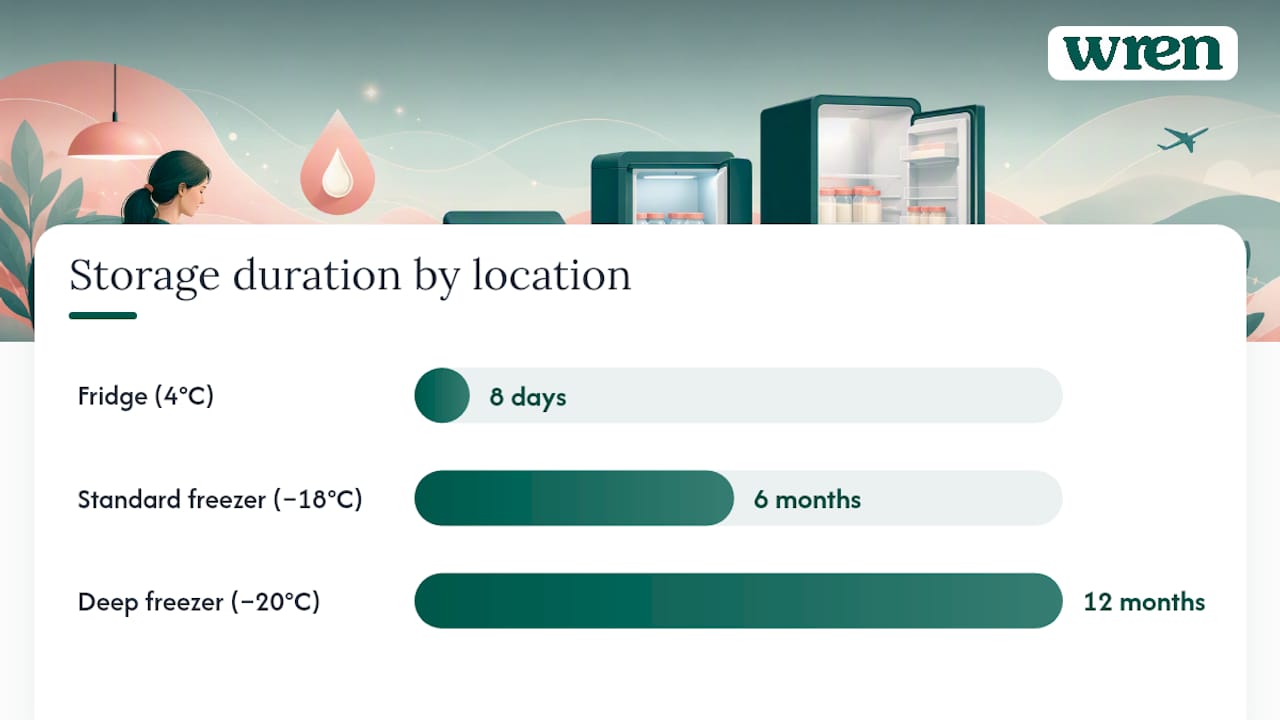
Temperature is the single biggest factor in how long milk keeps its quality, and the numbers are worth pinning to your fridge door.
According to NHS guidance, milk stored at −18°C or colder, which is a standard freezer compartment, holds its best quality for up to 6 months. Push it to 12 months and it’s still generally acceptable, but you’re trading some nutritional and taste quality for that extra shelf life.
A standard freezer at −18°C keeps milk at best quality for several months. A deep freezer holding steady at −20°C or colder allows for longer storage, though the shorter period remains preferable for quality.
Here’s how the main storage locations compare:
- Standard freezer compartment (−18°C or colder): best quality for several months.
- Deep freezer (−20°C or colder): acceptable for longer periods, though the shorter duration is still preferable.
- Fridge (4°C or colder): up to 8 days if the fridge holds a reliably cold, steady temperature.
- Fridge door or ice compartments: avoid these where possible. NHS’s Best Start in Life guidance notes that door storage and small ice compartments run warmer and fluctuate more than the back of the appliance, shortening safe storage times unpredictably.
Position matters as much as the appliance itself. Store milk at the back of the shelf, away from the door, where temperature stays most stable. A fridge or freezer that’s opened constantly through the day, which most family kitchens are, runs warmer near the front than the reading on the thermostat suggests.
How do you freeze breast milk flat?
Freezing flat isn’t just a space-saving trick, though it does let you fit far more into a small freezer drawer. Flat bags also thaw faster and more evenly than a solid block in a rigid tub, which matters at 3am when you need milk ready in minutes, not hours.
The process is straightforward:
- Cool freshly expressed milk in the fridge first if it isn’t going straight into the freezer.
- Pour it into a breast milk storage bag, or a shallow, sealable freezer-safe tray if you’re using containers instead.
- Leave around 2.5cm of headspace at the top for expansion.
- Press out as much air as you can before sealing the bag fully.
- Lay the bag flat on a baking tray or a dedicated shelf until it’s completely solid.
- Once frozen solid, stand the bags upright in a row and label each one with the date and volume.
Pour slowly and use a funnel or the bag’s own spout if it has one, since a rushed pour is the most common cause of spilt milk and a soggy freezer shelf. Double-check the seal along the entire top edge before laying it flat.
Pro Tip: Use a plastic freezer-safe tray as a mould for the first hour of freezing. It keeps the bag flat and stops it slumping into odd shapes before it’s solid enough to stack.
What is the safest way to thaw and warm breast milk?
The safest method is also the slowest: move a bag or container from the freezer to the fridge the night before you need it, and let it thaw gradually overnight. If you need milk faster, place the sealed bag in a jug of warm water, or hold it under lukewarm running water, turning occasionally so it warms evenly.
What you should never do is put breast milk in the microwave. NHS guidance is explicit on this point: microwaves heat unevenly, creating scalding hotspots that can burn a baby’s mouth even when the container feels only lukewarm to the touch. Microwaving can also damage some of the antibodies and proteins that make breast milk valuable in the first place. Boiling milk directly on the hob carries the same risk of destroying heat-sensitive nutrients.
Once milk is fully thawed in the fridge, the clock starts ticking. NHS guidance recommends using it within 24 hours. If your baby starts a feed from that bottle, finish it within 1 hour and tip away whatever’s left, since saliva introduced during feeding changes the milk’s bacterial makeup.
The rule that trips people up most is refreezing. Once milk has been fully thawed, whether in the fridge or warmed to room temperature, it cannot go back in the freezer. Mayo Clinic is clear that refreezing thawed milk isn’t a safe option, however small the leftover amount feels.
A quick summary of the timings that matter most:
- Thawed in the fridge, unused: use within about a day.
- Warmed and offered in a bottle: finish promptly, then discard.
- Once thawed and warmed: never refreeze, even partially used portions.
For a full walkthrough of warming methods and common mistakes, our guide on warming breast milk safely covers water temperatures and timing in more detail, and our piece on how to thaw breast milk safely walks through the fridge and warm-water methods step by step.
How do you keep expressed milk hygienic from pump to freezer?
Good hygiene habits matter more than any single piece of equipment, and most of them take seconds.
Wash your hands with soap and water before you start expressing, every single time, even if you’ve just washed up. Clean and sterilise pump parts and any containers according to the manufacturer’s instructions rather than guessing, since different materials and pump designs have different cleaning requirements.

Where you can, pump directly into the storage container or bag you intend to freeze rather than pumping into a bottle and transferring afterwards. La Leche League notes that minimising transfers between containers helps preserve milk fat and cuts the number of opportunities for contamination.
A short checklist worth keeping near your pump:
- Wash hands thoroughly before every expressing session.
- Sterilise pump parts and bottles according to the manufacturer’s guidance, not just a quick rinse.
- Pump directly into the final storage container where possible, rather than decanting.
- Rotate stock oldest-first, and always reach for refrigerated milk before frozen.
- Wipe down pump surfaces and work areas regularly, particularly if expressing outside the kitchen.
Prioritising refrigerated milk over frozen isn’t just about convenience. Freshly refrigerated milk retains slightly more of its original nutrient profile than milk that’s been through a freeze-thaw cycle, so using it first genuinely helps your baby get the most from each feed.
How do you transport breast milk safely?
Carrying milk to nursery, work, or on a day out needs a bit more care than storing it at home, mostly because temperature control is harder to guarantee on the move.
An insulated cool bag packed with frozen ice packs is the standard approach. Pack milk containers upright where possible, keep them tightly packed against the ice packs, and get everything into a fridge or freezer as soon as you arrive at your destination.
Packed properly, La Leche League notes that a cooler with good ice packs can keep milk safely chilled for up to 24 hours. That’s a useful buffer, but it’s not licence to leave a cool bag in a warm car boot all afternoon. The goal is always to minimise the total time milk spends above 4°C, not to test the upper limit of what the cool bag can manage.
Practical points worth remembering:
- Check nursery policy on accepting frozen versus chilled milk before your baby’s first day.
- For flights, check the airline’s specific rules on carrying breast milk in cabin baggage.
- On long car journeys, top up ice packs at stops if you’re travelling more than a few hours.
Our guide to transporting breast milk safely has more detail on packing techniques for longer trips.
Why does frozen breast milk sometimes smell or taste different?
If thawed milk smells soapy, metallic, or faintly rancid, the most likely culprit is an enzyme called lipase, which breaks down milk fat over time in the freezer. The American Academy of Pediatrics confirms this change in taste doesn’t usually mean the milk has spoiled, but it does put some babies off feeding, particularly ones who are especially sensitive to flavour changes.
A few options if this happens regularly:
- Use frozen milk sooner rather than pushing towards the 6 or 12 month limits, since lipase activity increases the longer milk sits frozen.
- Scald milk briefly on the hob before freezing, just below boiling point, to inactivate the lipase enzyme. This can alter some of milk’s beneficial properties, so it’s a trade-off rather than a universal fix.
- Offer freshly expressed milk where you can, saving frozen stock for times when fresh isn’t available.
Pro Tip: Freeze a single small test portion from a new expressing session and thaw it before committing a whole batch to the freezer. If it smells fine after thawing, the rest of that batch almost certainly will too.
If your baby is premature, unwell, or consistently refusing feeds regardless of what you try, speak to a health visitor or GP rather than troubleshooting alone.
Can you mix fresh milk with frozen or refrigerated milk?
Combining batches is fine, provided you follow one firm rule: always cool freshly expressed milk before adding it to anything already chilled or frozen. Warm milk poured onto a frozen block will partially thaw the older milk, which then sits at an unstable temperature and shortens its safe storage life.
Milk expressed across a single 24-hour period can generally be combined into one container, so long as each batch is chilled first. Label the combined container with the earliest date among the batches you’ve mixed in, not the latest, since that’s the date that governs how long the mixture stays safe.
Keeping portion sizes consistent across your freezer stash makes rotation and thawing far simpler, and it cuts down on the small amounts of leftover milk that so often end up wasted.
Paul at Wren: a short practical perspective
Freezing breast milk trips people up not because it’s complicated, but because it asks for consistency at a time when consistency feels impossible. Nobody labels every bag perfectly at 2am with a newborn crying in the next room, and that’s fine. What actually protects your stash is a handful of small, repeatable habits: date on the bag before it goes in the freezer, portions sized for one feed, oldest stock at the front.
Some breast milk storage bags are designed around realistic use, not an idealised version of parenting where everyone has a system and sticks to it perfectly. Get the temperatures right, respect the thawing rules, and don’t overthink the rest. If you want more on the practical side of storage and handling, our other guides on milk storage safety go into more detail on specific scenarios.
— Paul
How Wren’s breast milk storage bags can help
Getting freezing right depends on the container as much as the technique, and this is where Wren’s breast milk storage bags do the heavy lifting.
Some breast milk storage bags are made from food-grade material designed to be leak-proof once sealed, which matters when a bag is lying flat on its side in a crowded freezer drawer. A flat-lay shape follows the freezing-flat method described above almost exactly, so it enables faster, more even thawing and a freezer stash that stacks upright instead of sprawling across every shelf. Each bag typically has space for the date and volume, which makes the oldest-first rotation habit far easier to stick to on a tired morning.
If you’re setting up a freezer stash for the first time, or your current bags keep splitting at the seal, it’s worth browsing the full range of storage bags and picking a pack size that matches how often you express.
Sources
- Expressing and storing breast milk – NHS
- Storing human milk – La Leche League International
- Milk storage guidelines – American Academy of Pediatrics (overview)


