


Tandem nursing and pumping: practical plans for mums


Yes, you can tandem nurse and pump at the same time. Most parents manage it safely, provided the newborn feeds first and milk removal stays frequent and effective. The key caveats are straightforward: let the newborn latch before the toddler, watch wet nappies and weight closely in the early days, and treat any pumping session as a supplement to nursing rather than a replacement for it unless a feed is genuinely missed.
A few practical signposts before you read on:
- Prioritise the newborn for colostrum in the first days. Colostrum is produced in small, concentrated amounts and the newborn needs it most.
- Session length: when replacing a missed feed with a pump, aim for 15–20 minutes to remove milk thoroughly.
- Frequency: parents managing high demand or exclusively pumping alongside nursing are generally advised to aim for 8–12 sessions per 24 hours in the early weeks.
- Equipment worth considering: a hands-free double electric breast pump, a single wearable pump for one-sided expression, and a lactation massager to relieve engorgement and support let-down.
Key takeaways
Tandem nursing and pumping works best when the newborn feeds first, milk removal stays frequent, and the right equipment keeps your hands free for positioning.
| Point | Details |
|---|---|
| Newborn always feeds first | Prioritise the newborn for colostrum and early feeds; offer the fuller breast to them before the toddler. |
| Pump 15–20 minutes to replace a feed | Pump close to the usual feed time and run for 15–20 minutes to maintain supply effectively. |
| Aim for 8–12 daily sessions in early weeks | High-demand feeding requires frequent milk removal; tandem nursing helps maintain this. |
| Monitor intake closely | Track wet nappies, weight gain, and feeding behaviour; contact a clinician if red flags appear. |
| My-wren wearable pumps free your hands | Hands-free double and single pumps from My-wren let you express while positioning and holding two children. |
Table of Contents
- What does tandem nursing and pumping actually mean?
- Is tandem nursing and pumping safe?
- What to do in the first hours and days
- Practical holding positions for tandem nursing
- How to pump while tandem nursing: equipment, cleaning and storage
- How to manage milk supply, oversupply and fast let-down
- Sample schedules for tandem nursing and pumping
- Troubleshooting: latch issues, pain, mastitis and red flags
- The emotional side: setting limits and gentle weaning
- Practical tips for labour and birth when you plan to tandem nurse
- One-week quick checklist
- Wren’s hands-free pumps and lactation massager for tandem nursing
- Sources
What does tandem nursing and pumping actually mean?
Tandem nursing means breastfeeding two children of different ages, most commonly a newborn and a toddler, either at the same time or in close succession. Adding pumping into that picture means using a breast pump to replace a missed feed, build a frozen supply, relieve engorgement, or top up a newborn whose latch is still developing.
The scenarios where this combination tends to come up:
- Newborn plus nursing toddler. The most common setup. The toddler continues nursing after the new baby arrives, and pumping fills gaps when the toddler is at nursery or when the newborn needs more than one breast can offer at a single session.
- Breastfeeding through pregnancy, then continuing. Some parents nurse throughout pregnancy and transition directly into tandem nursing after birth. Pumping here often serves as a supply-maintenance tool during the pregnancy months when hormonal changes reduce output.
- Twins or multiples with pump support. When two newborns cannot always latch simultaneously, one nurses while the other is fed expressed milk, and pumping keeps both sides stimulated.
- Returning to work. A parent who tandem nurses at home may need to pump during work hours to maintain supply for the newborn and keep the toddler’s feeds available.
Who benefits most from this combination? Parents who need flexible milk storage, those managing an inefficient newborn latch alongside an experienced toddler nurser, and anyone whose lifestyle means feeds cannot always happen on demand. Tandem feeding guidance from the Australian Breastfeeding Association puts it plainly: feed together, one after the other, or at different times. Choose what works and adapt as demands change.
Is tandem nursing and pumping safe?
The short answer is yes, for most parents and most children. Both La Leche League International and the NHS consider tandem feeding generally safe. Pumping alongside nursing adds no meaningful risk beyond the physical demands of frequent milk removal.
During pregnancy, continued nursing is a personal choice. Supply often drops around months four to five due to hormonal shifts, and the milk’s taste may change. Neither pumping nor nursing can fully reverse a hormonally driven reduction, so if your toddler loses interest during pregnancy, that is a normal response rather than a problem to fix.
After birth, the priority is clear: the newborn feeds first, every time. Colostrum is produced in small volumes precisely calibrated for a newborn’s stomach, and an efficient toddler can drain a breast faster than a newborn can establish a latch. Offer the newborn the fuller breast first.
Monitoring newborn intake is non-negotiable in the early days. Track:
- Wet nappies: at least six per day by day five or six.
- Dirty nappies: frequency varies, but look for a pattern.
- Weight: expect a small dip in the first days, then a return to birth weight by around two weeks.
- Feeding behaviour: a satisfied newborn releases the breast, looks relaxed, and sleeps between feeds.
When to contact a clinician without delay:
- Newborn has fewer than six wet nappies per day after day five.
- Poor or no weight gain after the first week.
- Persistent latch pain that does not resolve with position changes.
- Signs of mastitis: a hard, red, warm area on the breast with flu-like symptoms.
- Severe, unrelieved engorgement.
- A newborn who is lethargic, difficult to rouse, or vomiting persistently.
Pro Tip: Keep a simple nappy and feed log for the first two weeks. A notes app works fine. It takes thirty seconds per feed and gives your midwife or health visitor exactly what they need to assess the newborn’s intake at a glance.
What to do in the first hours and days
The immediate postpartum period sets the tone for everything that follows. A clear sequence helps.
- Skin-to-skin straight away. Hold the newborn skin-to-skin as soon as possible after birth. This triggers the first feeding instinct and supports your hormone response.
- Let the newborn latch first. Before the toddler nurses, offer the breast to the newborn. If both children want to feed simultaneously, position the newborn first, then bring the toddler in.
- Offer the fuller breast to the newborn. Many parents find the newborn feeds more effectively from whichever side feels heavier. The toddler can finish that breast or take the second side.
- Record feeds from the start. Note the time, which breast, and roughly how long. This is your baseline for spotting problems early.
- Count nappies daily. Wet and dirty nappy counts are the most reliable early indicator of adequate intake.
- Attend every scheduled weight check. Your midwife will arrange these. Do not skip them in the first two weeks.
- Log pumping volumes if you pump. Even rough notes help you spot supply trends.
Managing the toddler’s emotional needs in those first days takes patience. Some toddlers become clingy or demand more frequent nursing than before. Others pull back. Both responses are normal. Short, calm explanations (“the baby needs milk first, then it’s your turn”) work better than lengthy negotiations. If the toddler is present at the birth or visits soon after, having a familiar adult nearby to hold or distract them while you establish the newborn’s latch makes the first feeds calmer for everyone.
Practical holding positions for tandem nursing
Getting two children onto the breast at the same time is a physical puzzle, and the solution depends on your body, your children’s sizes, and whether you are also pumping. These are the positions most commonly used, drawn from guidance on tandem holds and twin-nursing practice:
- Double football (rugby) hold. Both children tucked under your arms, one on each side, facing inward. Works well for newborns and smaller toddlers. Leaves your lap free and makes it easier to see both latches. A firm nursing pillow under each child reduces arm strain.
- Double cradle. Both children lying across your body, heads at the breast, bodies crossing or parallel. Suits a relaxed, reclined position. Harder to manage if the toddler is large.
- Laid-back (biological nurturing) hold. You recline at roughly 45 degrees. The newborn lies tummy-down on your chest; the toddler nurses from the side or lies alongside. Gravity helps with latch and reduces the effort of holding.
- Side-lying. You lie on your side; the newborn nurses from the lower breast while the toddler nurses from the upper breast or lies behind you. Useful for night feeds and rest periods.
Combining a pump with these positions:
- In the double football hold, attach a hands-free wearable pump to whichever side the toddler is not using, if the toddler is nursing one-sided.
- In the laid-back position, a wearable pump sits inside a pumping bra and runs without you holding it, leaving both hands free for positioning.
- When only the newborn is nursing, pump the opposite side simultaneously using a single wearable pump or a double pump.
Comfort and safety:
- Use a large nursing pillow or a standard pillow under each child to bring them to breast height rather than hunching forward.
- Switch sides between feeds to balance stimulation and supply on both breasts.
- Keep a glass of water and a snack within arm’s reach. A well-stocked nursing station reduces the logistical burden of long sessions considerably.
Pro Tip: Before you sit down for a tandem session, do a thirty-second setup: phone, water, snacks, burp cloth, and pump parts all within reach. The hardest part of tandem nursing is being physically immobile for twenty minutes with nothing you need nearby.
How to pump while tandem nursing: equipment, cleaning and storage
Choosing your equipment
The right pump depends on what you are trying to achieve in each session.
- Hands-free double electric breast pump: the most efficient option when both children are not nursing simultaneously. Pumps both sides in one session, maximises stimulation, and halves expression time. NHS guidance for parents feeding multiples specifically recommends double pumping to maximise production and reduce time spent expressing.
- Single hands-free wearable pump: ideal when one child is nursing on one side and you want to express the other side at the same time. Sits inside a pumping bra, runs quietly, and keeps your hands free for positioning.
- Lactation massager: not a pump, but a useful companion. Use it before or during a session to stimulate let-down, soften a blocked area, or relieve engorgement. Particularly helpful in the early days when let-down can be slow or uneven.
- Spare flanges and storage containers: keep a second set at the nursing station so a dirty flange never stops a session.
| When to use | Hands-free single | Hands-free double | Traditional double |
|---|---|---|---|
| One child nursing, one side free | Best fit | Unnecessary | Awkward to hold |
| Both children nursing simultaneously | Not practical | Not applicable | Not applicable |
| Both children sleeping, need to express | Slower but hands-free | Best fit | Efficient but requires both hands |
| Replacing a missed feed | Adequate | Faster | Fastest output |
| Typical session length | 15–20 min | 15–20 min | 15–20 min |
Cleaning and storage
Milk pumped during tandem nursing follows the same hygiene rules as any expressed milk:
- Rinse pump parts in cold water immediately after use, then wash in hot soapy water or run through a dishwasher on a hot cycle.
- Sterilise parts once daily in the early weeks, particularly for a newborn under three months.
- Label every storage bag or container with the date and volume before refrigerating or freezing.
- Refrigerated milk keeps for up to four days at 4°C or below. Frozen milk keeps for up to six months in a dedicated freezer.
- Never add warm freshly pumped milk directly to cold stored milk. Cool it first in the fridge.
Pro Tip: Keep a small basket at your nursing station containing two clean flanges, a pumping bra, storage bags, a marker pen, and a spare charging cable for your pump. When a session ends, you restock the basket rather than hunting for parts at the next feed.
How to manage milk supply, oversupply and fast let-down
Supply follows demand. Frequent, effective milk removal, whether by nursing or pumping, is what drives production. A single long session does not compensate for several missed ones. La Leche League UK confirms that the extra stimulation from a toddler who nurses efficiently often increases total milk volume to meet combined demand, though this does not automatically mean oversupply.
Signs of oversupply and fast let-down:
- Breasts feel very full between feeds, even with frequent nursing.
- Milk sprays forcefully at let-down.
- The newborn gulps, chokes, or pulls off the breast repeatedly.
- The newborn has green, frothy stools (a sign of taking in more foremilk than hindmilk).
Stepwise strategies to reduce oversupply:
- Block feeding: nurse from one breast only for a set block of time (two to four hours), then switch. This allows the fuller breast to signal the body to reduce output.
- Laid-back positioning: gravity slows the flow and gives the newborn more control.
- Paced nursing: allow the newborn to pause and breathe between swallows rather than letting milk flow continuously.
- Express only for comfort: if you pump to relieve engorgement, remove just enough to take the edge off rather than fully emptying, which would signal the body to produce more.
Using pumping strategically:
When the goal is to replace a missed feed, pump as close to the usual feed time as possible and run the session for 15–20 minutes. When the goal is to build a frozen supply, add one short pump session after a morning nursing session, when output tends to be highest. For supply-boosting strategies, consistent frequency matters more than session length.
Recurrent blocked ducts or mastitis that does not clear within 24 hours of frequent feeding, warmth, and rest needs prompt medical attention. Left untreated, mastitis can develop into an abscess. Contact your GP or midwife the same day if you have a hard, red, painful area alongside a fever above 38°C.
Pro Tip: To phase out pumping or toddler feeds gradually, reduce by one session every three to five days rather than stopping abruptly. Sudden cessation risks severe engorgement and blocked ducts. A lactation massager used during the transition helps soften the breast and ease discomfort as supply adjusts.
Sample schedules for tandem nursing and pumping
Frequency matters. Great Ormond Street Hospital guidance notes that full milk production typically runs at 25–35 oz (approximately 740–1,035 ml) per 24 hours, and parents managing high-demand feeding are generally advised to aim for 8–12 sessions in that period during the early weeks. Tandem nursing usually reduces the need for every session to be a pump session, because the toddler provides additional stimulation.
The three templates below are starting points. Adapt them to your children’s actual rhythms.
| Time | Schedule A: at home, tandem nursing | Schedule B: returning to work | Schedule C: newborn latch support |
|---|---|---|---|
| — | Nurse newborn, then toddler | Nurse both before leaving | Nurse newborn, pump opposite side |
| — | Nurse newborn on demand | Pump at work (15–20 min) | Nurse newborn |
| — | Nurse newborn, toddler nap | Pump at work (15–20 min) | Pump both sides (15–20 min) |
| — | Nurse newborn, offer toddler | Pump at work (15–20 min) | Nurse newborn |
| — | Nurse newborn on demand | Pump at work if needed | Pump both sides |
| — | Nurse newborn, toddler feed | Return home, nurse both | Nurse newborn |
| — | Nurse newborn | Nurse both | Pump both sides |
| — | Nurse newborn, toddler bedtime | Nurse newborn | Nurse newborn |
| — | Nurse newborn | Pump before bed | Pump both sides |
| Night | Nurse newborn on demand | Nurse newborn on demand | Nurse or pump on demand |
How to adapt these templates:
- During cluster feeding (typically evenings in the early weeks), drop any planned pump session and let the newborn nurse on demand. The cluster itself provides the stimulation.
- When the toddler demands comfort feeds at unusual times, offer the breast if you can. Toddler nursing sessions are usually short and add stimulation without significantly depleting the newborn’s supply.
- For night clusters, prioritise rest over pumping. If the newborn is nursing frequently overnight, your supply is being maintained. Add a pump session only if you are trying to build a frozen reserve.
Pro Tip: For returning to work, set a phone reminder for each pump session in the first two weeks back. It is easy to push sessions back when meetings run over, and even a 30-minute delay repeated across a day can reduce output noticeably.
Troubleshooting: latch issues, pain, mastitis and red flags
Common problems and immediate steps
Poor latch (newborn): Check that the newborn’s mouth covers a wide arc of the areola, not just the nipple. The chin should press into the breast and the nose should be clear. If the latch is shallow, break the seal with a clean finger and try again. A lactation consultant (IBCLC) can assess latch in person and often resolves the issue in one or two sessions.
Nipple pain and cracking: Some tenderness in the first week is normal. Sharp, shooting pain, or pain that persists beyond the first minute of a feed, is not. Apply a thin layer of nipple balm after feeds and allow nipples to air-dry. If pain is severe or nipples are cracked and bleeding, contact a health visitor or lactation consultant before the next feed rather than waiting.
Pumping discomfort: Check flange size. A flange that is too small compresses the nipple and causes pain; one that is too large pulls in too much areola tissue. Most pump brands offer multiple flange sizes, and getting the fit right makes a significant difference to both comfort and output.
Mastitis: Signs include a firm, red, warm area on the breast, often with flu-like aching and a temperature above 38°C. First-line steps: continue nursing or pumping frequently from the affected side, apply warmth before feeds and cold after, rest as much as possible, and drink plenty of fluids. If symptoms do not improve within 12–24 hours, contact your GP. Antibiotics are often needed and are compatible with breastfeeding.
If your newborn has fewer than six wet nappies per day after day five, has not returned to birth weight by two weeks, is difficult to rouse for feeds, or is vomiting persistently, contact your midwife or health visitor the same day. These are not “wait and see” situations.
Contacts to have saved:
- Your community midwife (for the first ten days postpartum).
- Your health visitor (from day ten onwards).
- An IBCLC or local lactation consultant.
- Your local breastfeeding support group (La Leche League, NCT, or a hospital-run group).
The emotional side: setting limits and gentle weaning
Tandem nursing is physically demanding, and the emotional load is real. Feeling “touched out” — a sense of sensory overload from constant physical contact — is one of the most commonly reported experiences among tandem nursing parents, and it does not mean something is wrong with you or your feeding relationship.
Setting limits with a toddler:
- Use short, consistent language: “Milk is sleeping right now. We’ll have milk after lunch.”
- Offer an alternative: a cuddle, a snack, or a specific activity.
- Keep the limit calm and predictable. Toddlers respond to consistency more than explanation.
- La Leche League International notes that a toddler who had previously weaned may re-latch after the newborn arrives. The approach “don’t offer, don’t refuse” works well for many families during this transition.
Gentle weaning options:
- Reduce the least important session first, usually a daytime comfort feed rather than a morning or bedtime one.
- Shorten sessions gradually over one to two weeks before dropping them.
- Replace the session with a different ritual: a story, a song, or a special drink.
- Wait three to five days between dropping each session to allow supply to adjust without engorgement.
- Use a lactation massager to soften the breast during the adjustment period.
Finding support:
Local breastfeeding groups, online communities such as the La Leche League forums, and NHS peer support programmes all offer non-judgmental spaces to talk through the emotional complexity of tandem nursing. Even five minutes of slow breathing before a feed, or a deliberate pause between sessions, can reduce the physical tension that builds during long days of continuous nursing.
Practical tips for labour and birth when you plan to tandem nurse
Planning ahead makes the first hours smoother.
- Tell your birth team. Let your midwife or obstetrician know before labour that you plan to tandem nurse. They can arrange early breastfeeding support, prioritise skin-to-skin time, and flag any concerns about the newborn’s intake from the start.
- Plan for immediate skin-to-skin. Request this in your birth preferences. Even a few minutes of uninterrupted skin-to-skin after birth supports the newborn’s first latch and your hormone response.
- Let the newborn feed first at the breast. In the first hours, the newborn takes priority over the toddler every time.
- Ask about expressing colostrum. If the newborn cannot latch immediately, ask a midwife to help you hand-express colostrum into a small syringe or cup. This can be stored and given to the newborn while latch is established.
- Store expressed colostrum safely. Colostrum expressed in hospital can be refrigerated for up to 24 hours or frozen for later use.
If the toddler is present or visits soon after birth:
- Have a familiar adult with the toddler at all times so you can focus on the newborn’s first feeds.
- Prepare a simple explanation in advance: “The baby needs milk from mummy’s body to grow strong. You can have your turn soon.”
- Keep the toddler’s first visit short if possible, particularly if you are still establishing the newborn’s latch.
Additional considerations:
- If you had a caesarean, positioning will need adjustment in the early days. Tips for breastfeeding after a C-section cover the specific holds and support strategies that work best during recovery.
- Ask the hospital team to weigh the newborn before discharge and confirm a follow-up weight check within 48–72 hours.
One-week quick checklist
Do this today:
- Feed the newborn first at every session.
- Track wet and dirty nappies from birth.
- Set up a nursing station: water, snacks, cushions, pump parts, storage bags, and a phone charger.
- Save your midwife’s and health visitor’s numbers.
Try this week:
- Experiment with at least two different tandem positions to find what works for your body.
- Follow one of the sample schedule templates and adjust after two to three days based on your children’s actual patterns.
- Add one morning pump session after the first nursing feed to begin building a small frozen reserve.
- Read up on hands-free pumping to understand how wearable pumps fit into tandem workflows.
Seek help if:
- The newborn has fewer than six wet nappies per day after day five.
- The newborn has not returned to birth weight by two weeks.
- You have persistent, severe nipple pain beyond the first week.
- You develop a hard, red, warm area on the breast with a fever.
- You experience recurrent blocked ducts more than once in a week.
A note from Paul
Tandem nursing and pumping is one of those topics where the gap between “it’s possible” and “here’s how to actually do it” is enormous. Most of the content out there tells you it can be done. Very little tells you what to do when the toddler is climbing over you, the newborn is fussing, and the pump alarm is going off at the same time.
What I find most useful to emphasise, having written extensively on breastfeeding and maternal wellness, is this: the newborn-first rule is not a rigid hierarchy that makes the toddler feel rejected. It is a practical safeguard for the first two weeks, after which most parents find a rhythm that works for both children. The emotional weight of tandem nursing is real, and setting limits is not a failure. It is how this becomes sustainable.
The parents who manage tandem nursing and pumping well tend to share one habit: they set up their environment before they need it. A nursing station, a charged pump, a clear schedule. The logistics are manageable when the kit is ready. The rest follows.
Wren’s hands-free pumps and lactation massager for tandem nursing

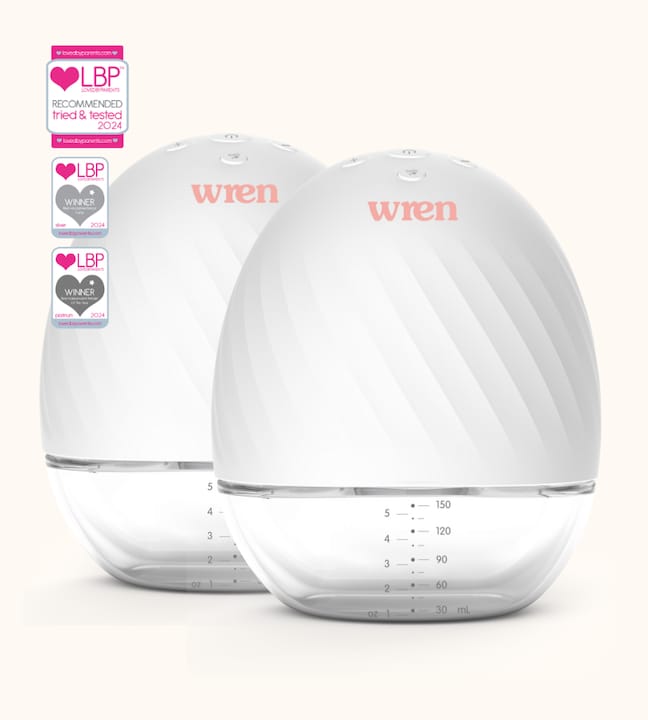
When you are nursing two children and trying to pump at the same time, having both hands occupied is not an option. Wren’s hands-free double electric breast pump sits discreetly inside a pumping bra and runs quietly while you position, hold, and settle two children. No tubes to manage, no pump to prop up. For sessions where only one side needs expressing while the other is nursing, the single wearable pump does the same job on one breast without interrupting the feed on the other.
The Wren lactation massager is worth keeping at the nursing station for the moments when let-down is slow or a duct feels blocked. A brief massage before attaching the pump or during a feed can make a noticeable difference to comfort and output. Browse the full range at My-wren and find the setup that fits your tandem nursing workflow.
Sources
- Breastfeeding and expressing milk — Great Ormond Street Hospital
- Milk supply — NHS
- Tandem nursing — La Leche League International (UK)
- Breastfeeding during pregnancy and tandem nursing — La Leche League International
- Tandem feeding — Australian Breastfeeding Association
This article is general information, not a substitute for advice from a qualified doctor. Consult a qualified healthcare professional about your own circumstances before acting on anything here.


